A West Texas Landowner’s Perspective on Stewardship and Water Responsibility
Water in the Desert 2026
Feb. 12 – 9:00am Session
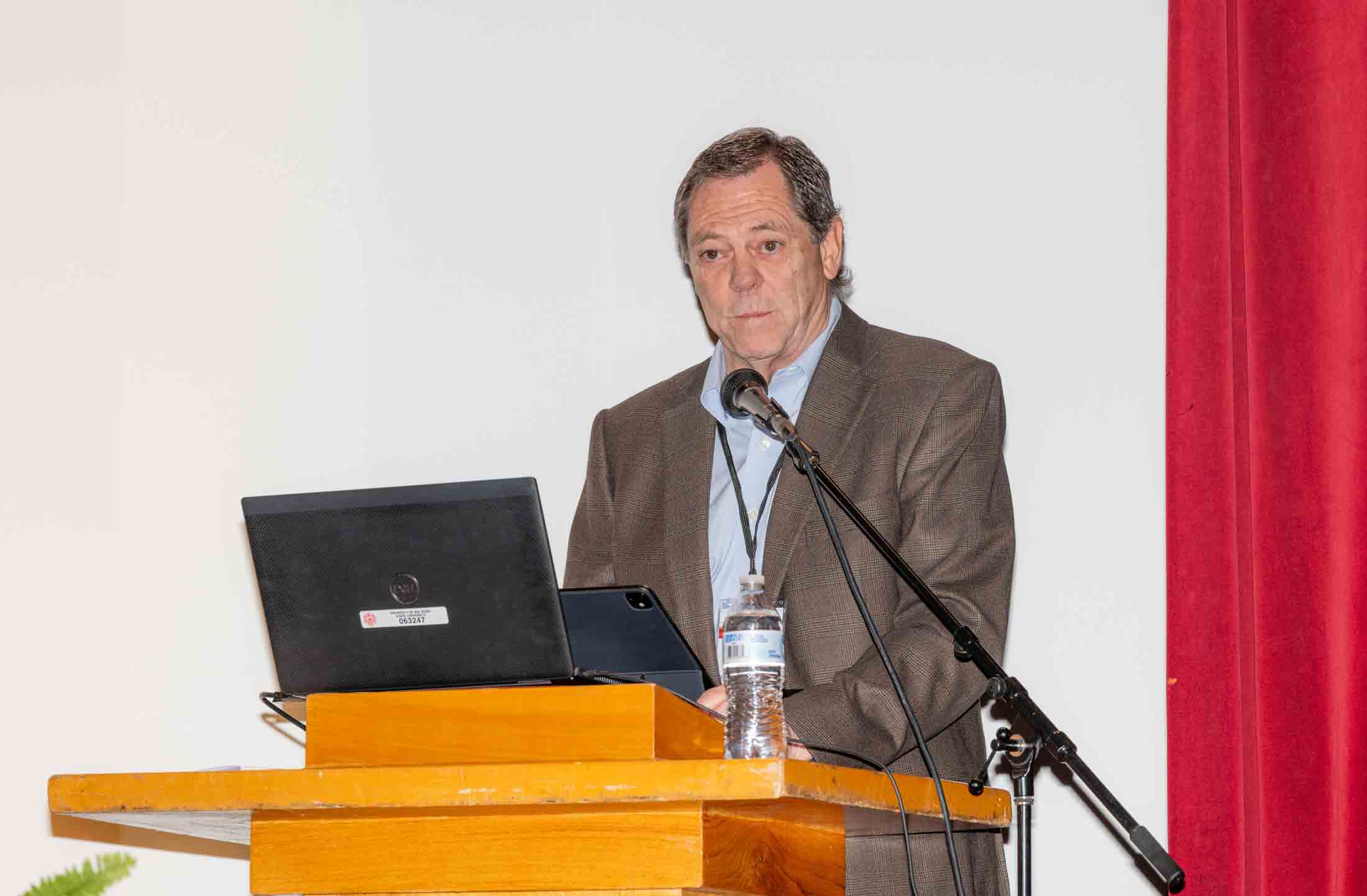
The second day of Water in the Desert 2026 opened with welcoming remarks from Dr. Louis Harveson of Sul Ross State University, followed by keynote reflections from West Texas landowner and Texas Parks and Wildlife Commission Chairman Paul Foster.
Harveson, director of the Borderlands Research Institute and associate provost for research and development at Sul Ross State University, thanked attendees and sponsors for helping the conference grow rapidly since its inception.
“We’ve come a long way in a short amount of time,” Harveson said. “We couldn’t do it without our sponsors and partners. There is a wonderful community of conservation partners in Far West Texas that really work together to take care of the very special place that we live.”
He also highlighted the momentum behind the newly established Meadows Research Institute for West Texas Water, which hosted the conference.
“Typically it takes years, sometimes decades, for an institute to become established and begin producing results,” Harveson said. “But with the support of the Meadows Foundation and the overwhelming success of this conference, that timeline has accelerated.”
Harveson described the event as a cornerstone for the institute’s future work and thanked participants for helping elevate water issues across the region.
“This is a signature conference that our institute will move forward in future years,” he said. “Your participation, your attendance and your engagement have helped prioritize water in the desert as a priority.”
Harveson then introduced Foster, noting his leadership, philanthropy and service to Texas. Foster serves as chairman of the Texas Parks and Wildlife Commission, but spoke to the audience primarily from the perspective of a West Texas landowner.
Foster opened his remarks with humor, acknowledging the commitment required to attend a conference focused on water in one of the driest parts of the state.
“Anyone who shows up to talk about water in West Texas is not here by accident,” Foster said. “You’re either deeply committed or you’ve made some questionable life choices — and I can count myself in both categories.”
He praised organizers for convening such a diverse group of stakeholders.
“There’s nothing easy about bringing together landowners, scientists, conservationists and water managers in West Texas and then asking them to agree on anything,” Foster said. “But it shows how vital and important this topic is.”
Foster also recognized the role of the Meadows Research Institute and the philanthropic investment that made it possible.
“The Meadows Foundation’s extraordinary commitment reflects a long-term belief in collaboration and practical, science-based solutions for water in West Texas,” he said.
Although Foster serves in statewide leadership roles, he emphasized that his comments were offered from the perspective of someone who owns and manages land in the region.
“I’m honored to be with you today not just as chairman of Texas Parks and Wildlife, but as a fellow landowner and neighbor,” Foster said. “Like many of you, I don’t just care about this place. I’m invested in it — literally, yes, but more importantly, generational.”
Foster owns the KC Ranch and the Glass Mountain Ranch near Balmorhea. When he purchased the KC Ranch, he commissioned a detailed groundwater study to better understand the aquifers and springs beneath the property.
“I didn’t just want to know how much water might be under the ranch,” he said. “I wanted to know where it went, how it interacted with other aquifers and springs, and who else depended on it.”
The study revealed a complex groundwater system with connections extending far beyond property boundaries.
“That study made one thing very clear to me,” Foster said. “Water doesn’t respect ownership the way we might like it to. It moves, it connects, it disappears, and decisions made in one place can have significant consequences somewhere else.”
He noted that at one time springs on the ranch discharged more than 30,000 acre-feet of water per year — an amount that reflects the scale of the regional aquifer system.
“That doesn’t come from a backyard aquifer,” Foster said. “That comes from a regional system.”
Through additional testing, researchers also determined that some of the groundwater beneath the ranch is tens of thousands of years old.
“Some of the water under my ranch is over 35,000 years old,” Foster said. “If you think about that, it reminds us that the decisions we make about water today have very long-lasting impacts.”
The studies also showed that large volumes of groundwater could potentially be produced and sold commercially. But Foster ultimately chose not to pursue that option.
“I bought the ranch because I love the land,” he said. “The conclusion I reached was that for me it was better not to pump that water.”
He acknowledged that every landowner must make their own decisions but said stewardship played a central role in his.
“As the owner of 55,000 acres of West Texas ranchland, I have a responsibility not only to my neighbors but to the future,” Foster said. “That may not be the right decision for every landowner, but for me it was the right decision.”
Foster said that sense of responsibility — and the recognition that water systems are interconnected — is what makes gatherings like Water in the Desert important.
“The aquifers, the springs, the rivers and the land are all connected,” he said. “Ignoring that reality doesn’t preserve anything. It just postpones the consequences.”
He closed on an optimistic note, praising the collaborative spirit of the conference.
“What gives me real optimism is that you’re not waiting for a crisis to force cooperation,” Foster said. “You’re choosing data over guesswork and long-term thinking over short-term fixes.”
Sponsors and Organizing Partners
This conference session excerpt is from Water in the Desert 2026.
Water in the Desert 2026 was hosted and organized by the Meadows Research Institute for West Texas Water at Sul Ross State University.
The conference was made possible through the generous financial support of its major sponsors — Horizon Foundation, Dixon Water Foundation, and Reeves County Groundwater Conservation District — whose leadership investment ensured the event remained accessible and affordable to attendees from across the region.
Additional sponsors included Brewster County Groundwater Conservation District, Environmental Defense Fund, EHT–Enprotec Hibbs & Todd, Frontier Development Inc., Rio Grande Joint Venture, Texas Wildlife Association, and The Nature Conservancy.
The quality and depth of the program were shaped by a collaborative team of organizing partners, including Sul Ross State University, Borderlands Research Institute, Environmental Defense Fund, Rio Grande Joint Venture, Texas Water Foundation, Texas Agricultural Land Trust, Dixon Water Foundation, Texas Wildlife Association, The Nature Conservancy, Texas Parks and Wildlife Department, and Texas Parks and Wildlife Foundation.