Tried and true strategies for improving rangelands, slowing down water, and enhancing ecosystems and wildlife habitats
Water in the Desert 2026
Feb. 11, 1:30pm Session
At Water in the Desert 2026, the morning sessions focused on land trends, climate projections, and aquifer pressures. The 1:30 session shifted from data to dirt, exploring what landowners can do right now to strengthen watershed health across Far West Texas.
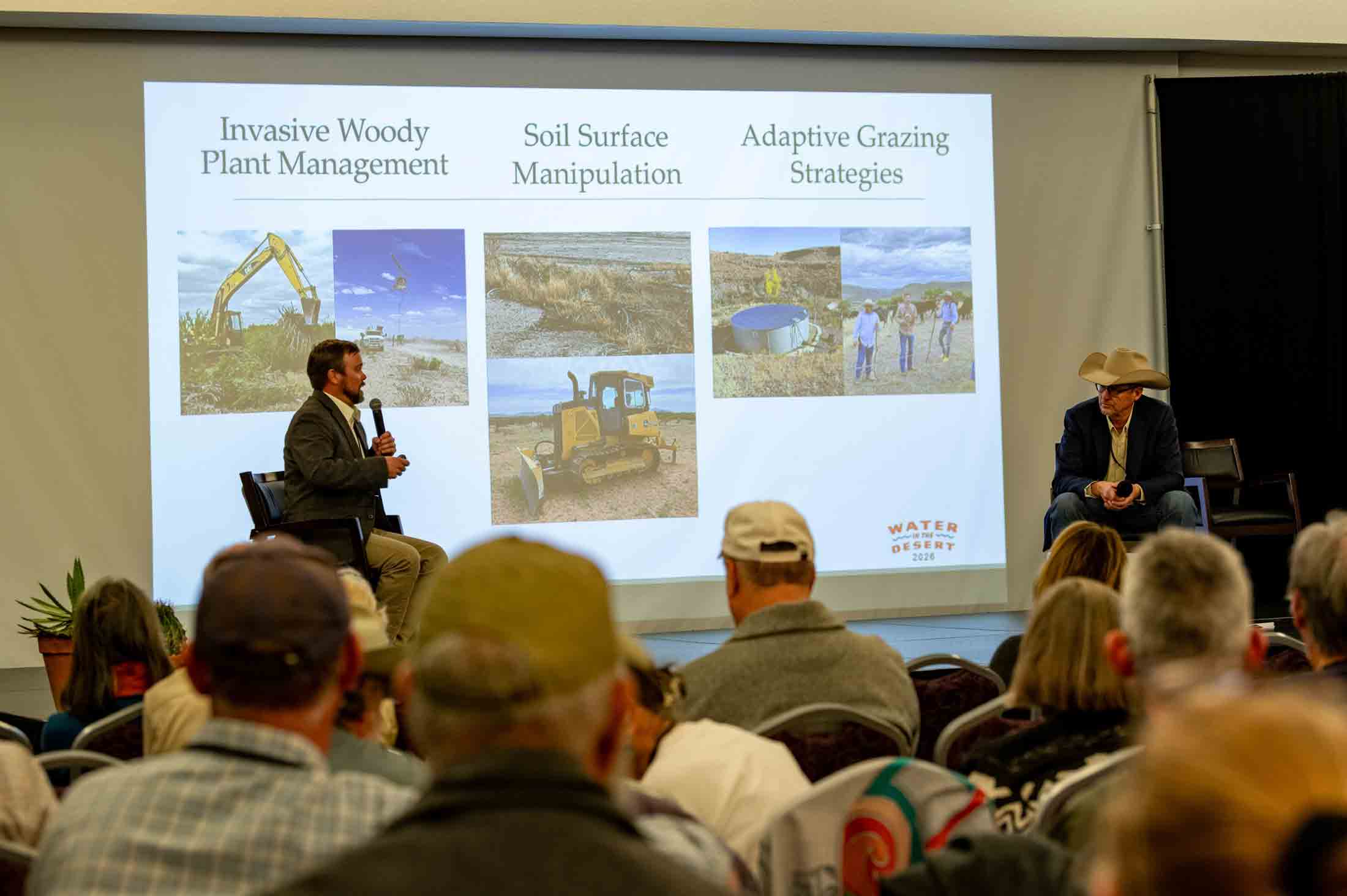
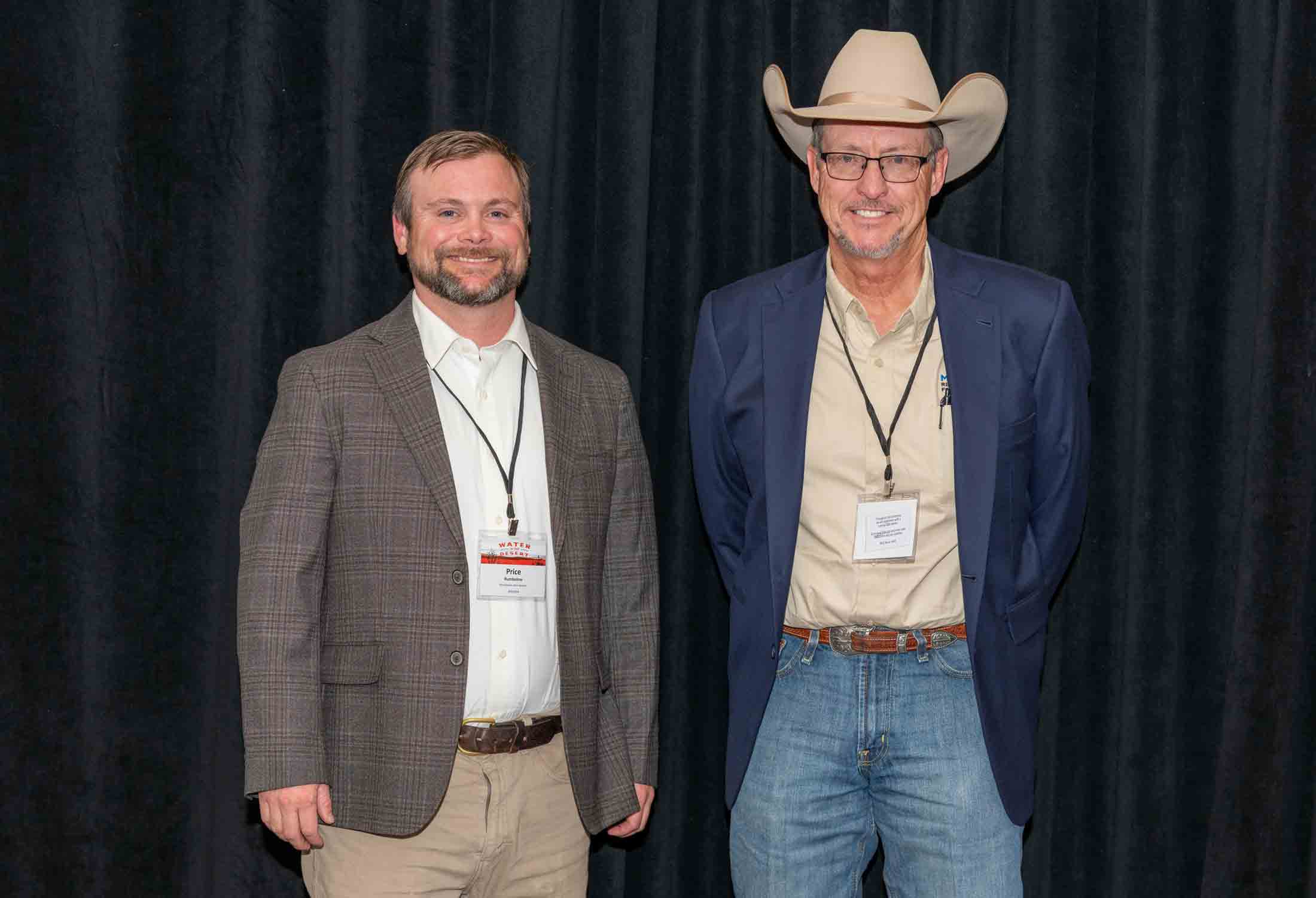
Billy Tarrant, interim director of the Meadows Research Institute for West Texas Water, joined Price Rumbelow, Conservation Delivery Coordinator for the Rio Grande Joint Venture, to outline practical strategies already underway across the Trans-Pecos to restore grasslands, stabilize streams, and help landscapes hold on to rainfall.
“We’re just giving the stream the medicine that it needs to heal itself,” Tarrant said. “And once it’s healed, if managed appropriately, our work is done.”
Watershed Health Begins with Grass
Rumbelow opened with a comparison of two patches of rangeland, one degraded and one recovering.
“If a half inch of rain fell in this area,” Tarrant asked, “which land type is gonna hold that water better? Which one’s gonna get more moisture in the soil? And which one’s gonna allow it to run off?”
In a region where rainfall is intense and episodic, the difference between infiltration and runoff determines whether water nourishes grass or disappears downstream.
Grassland loss across North America has been steep over the past 50 years, Rumbelow noted, affecting wintering birds in West Texas. But healthy grasslands also benefit ranchers.
“If you’re growing grass for wildlife,” Tarrant said, “you’re also growing grass for production for cattle.”
Adaptive grazing plays a central role. “It’s not a one-size-fits-all,” Tarrant emphasized. In West Texas, rainfall can vary dramatically even within a single ranch, making flexibility essential.
Tools in the Toolbox
The presenters described a range of restoration tools. Some involve mechanical treatments for woody encroachment. Others are simpler.
One example is “branch mulch,” placing woody debris across bare soil to create shade and improve moisture retention.
“It provides protection. It creates a microclimate. Keeps the soil cooler. Allows for germination. Holds moisture longer. Works like a charm,” Tarrant said.
Other strategies include soil-surface manipulation and targeted treatments that interrupt erosion and encourage grass response. Monitoring is key.
“We try to be adaptive in our management strategies,” Rumbelow explained.
The urgency is real. “It takes about a thousand years to regain one inch of soil loss under natural conditions,” he said. Preventing erosion is far easier than rebuilding soil.
Slowing Water, Rebuilding Streams
A major focus of the session was restoring ephemeral creeks through low-tech, nature-based structures such as loose rock dams, brush weirs, and beaver dam analogs.
“These are not new ideas,” Tarrant said. “They’ve been going on for thousands of years.”
When installed correctly, these structures trap sediment, rebuild floodplains, and encourage vegetation recovery. Over time, they can transform incised channels into functioning riparian systems.
One leaky weir installed in a Trans-Pecos watershed filled with sediment just two days after construction during a July rain event.
“It’s pretty shocking to think how much soil is being removed from our hillsides,” Rumbelow said.
The goal is not permanent infrastructure but restored natural processes. As vegetation returns, the system becomes more resilient and less dependent on continued intervention.
The Alamito Creek Model
Much of this work is concentrated in the roughly 1,000-square-mile Alamito Creek watershed, stretching from Jeff Davis County through Brewster County to the Rio Grande. The effort is part of the Alamito Creek Conservation Initiative (ACCI), a collaborative partnership advancing watershed restoration through research, landowner engagement, and on-the-ground demonstration projects.
By working at a watershed scale rather than isolated sites, the team hopes to build cumulative impact — slowing water, rebuilding soil, and restoring function across an entire system rather than a single reach.
“Watersheds build off each other,” Rumbelow said. “If you start to slow the water, then you get the water under control.”
Tarrant described the vision as catalytic. If landowners begin to see creeks flowing longer, even in stretches that now hold water only briefly after storms, the impact becomes visible.
“When you could see clear running water for a long period of time,” he said, “that makes an impact.”
Projects like those underway through ACCI also reflect the broader direction of the Meadows Research Institute for West Texas Water — pairing applied science with practical stewardship and collaborative delivery at a scale that matters.
Soil Moisture and Aquifer Questions
Audience members asked about the connection between land restoration, soil moisture, and aquifer health, particularly in a future of hotter droughts. Tarrant noted that the structures directly influence shallow riparian aquifers.
“As we build these structures, we are in theory directly impacting the riparian aquifer for sure.”
The relationship to deeper aquifers is more complex and remains an area of active research.
“It’s a hard nut to crack,” Rumbelow said. “Right now, the question is how do you measure that connection?”
Both speakers returned to a common theme: keeping water on the landscape longer increases the likelihood of infiltration rather than runoff.
“Trying to get more water into the soil, into the plants, and stop it from just shedding off of the watershed is more important,” he said.
Obstacles and Opportunity
Funding remains a primary hurdle. Current projects rely on incentives to encourage adoption, and scaling up will require sustained investment.
There are promising signs. The Natural Resources Conservation Service has added funding codes for some of these practices, signaling growing institutional support.
In the meantime, the approach remains hands-on and collaborative.
“We’re gonna come help set up a couple of ’em by hand,” Tarrant said. “And if you see the results, hopefully we can work with you. Or maybe you can do it yourself.”
In a landscape shaped by flash floods and long dry spells, preparation matters. As Rumbelow observed, “when it rains, we all look like good managers.”
The real work happens before the rain arrives. Stewardship for healthy watersheds begins upstream, on the ground, and often one rock at a time.
Sponsors and Organizing Partners
This conference session excerpt is from Water in the Desert 2026.
Water in the Desert 2026 was hosted and organized by the Meadows Research Institute for West Texas Water at Sul Ross State University.
The conference was made possible through the generous financial support of its major sponsors — Horizon Foundation, Dixon Water Foundation, and Reeves County Groundwater Conservation District — whose leadership investment ensured the event remained accessible and affordable to attendees from across the region.
Additional sponsors included Brewster County Groundwater Conservation District, Environmental Defense Fund, EHT–Enprotec Hibbs & Todd, Frontier Development Inc., Rio Grande Joint Venture, Texas Wildlife Association, and The Nature Conservancy.
The quality and depth of the program were shaped by a collaborative team of organizing partners, including Sul Ross State University, Borderlands Research Institute, Environmental Defense Fund, Rio Grande Joint Venture, Texas Water Foundation, Texas Agricultural Land Trust, Dixon Water Foundation, Texas Wildlife Association, The Nature Conservancy, Texas Parks and Wildlife Department, and Texas Parks and Wildlife Foundation.