A Conversation about agreements and conditions from the early 1900s that formed today’s Rio Grande and Pecos River Compacts, special water control districts and the 1944 Rio Grande Treaty
Water in the Desert 2026
Feb. 11, 2:30pm Session
If there was a session that underscored how West Texas water issues do not stop at county — or even state — lines, it was the afternoon conversation on the Rio Grande and Pecos River.
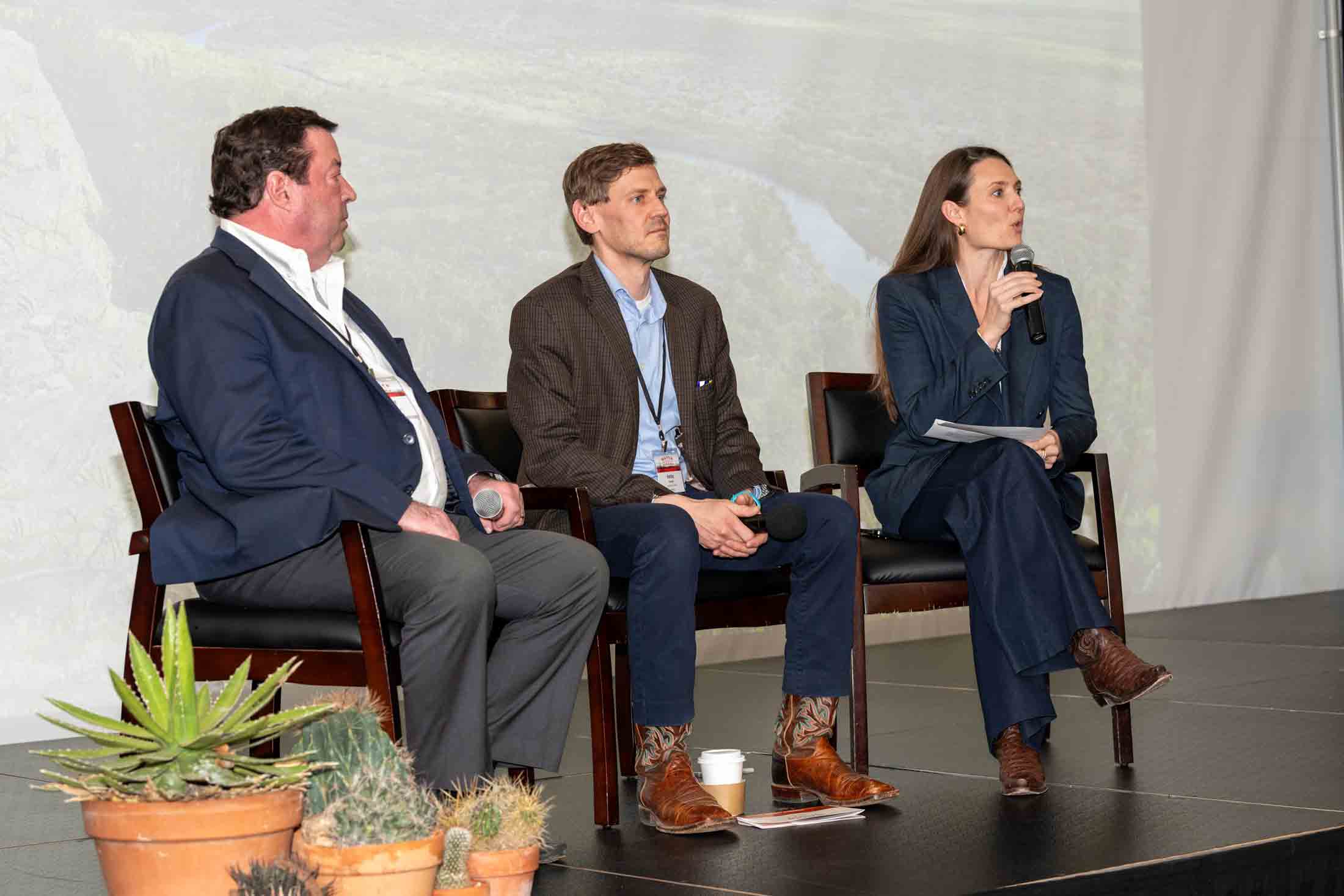
Moderated by Sarah Schlessinger of the Texas Water Foundation, the panel featured former TCEQ Commissioner Bobby Janecka and Lourcey Sams, president of the Pecos River Resolution Corporation. Together, they discussed the legal frameworks governing both rivers and the current conditions affecting flows in West Texas.
The Rio Grande: An International Balancing Act
The Rio Grande is governed by the 1944 Water Treaty between the United States and Mexico. Janecka, who previously served as Texas’ border commissioner at TCEQ, described recent challenges under the treaty.
He noted that Mexico recently completed a five-year delivery cycle at one of the lowest levels on record. Absent late-cycle releases, it would have set a historic low. In his words, “there’s no more water and too much need.”
Janecka described the river today as “desperately dire” and “decidedly struggling.” He emphasized that the Lower Rio Grande Valley is heavily dependent on the river, with approximately 90 percent of communities relying on Rio Grande surface water for drinking water supply. The system is fully allocated, and no new surface water rights are being issued.
Salinity was also discussed as a concern. Janecka explained that while agricultural return flows in Mexico have often been cited as a primary source, research has identified more complexity. He referenced salinity studies suggesting that groundwater interactions along the river corridor following rainfall events may contribute to spikes in salinity.
Janecka also addressed ongoing tensions surrounding treaty compliance. While the treaty operates on five-year delivery cycles, he discussed recent efforts to shift toward annual delivery expectations. Whether that approach will improve reliability remains to be seen.
The Pecos: A River in Visible Distress
For Sams, the Pecos River is both personal and professional. He described hunting ducks along the river near Girvin decades ago and spoke of having never seen it in worse condition.
He stated that long stretches of the Pecos in Texas are currently dry — including at Interstate 20, near Pecos, at Girvin, and north of Imperial — calling it “historically the worst” he has seen.
The Pecos River Compact, established in 1948 following disputes between Texas and New Mexico, was also discussed. Sams outlined the history of litigation that led to a 1987 U.S. Supreme Court decision requiring New Mexico to deliver additional water and monetary damages. He noted that there is currently no active litigation or dispute between the two states over compact compliance.
Operational issues were also raised. Sams pointed to Red Bluff Reservoir, constructed in 1937 to support irrigation districts, noting that it has not released water for environmental flows in recent years. He described how water stored in the reservoir becomes increasingly saline due to evaporation and the naturally salty characteristics of the river in Texas.
Unlike the Rio Grande, the Pecos does not serve major municipal populations in Texas. However, Sams emphasized that the absence of flows affects fish, wildlife, and migratory waterfowl, and he advocated for environmental releases from Red Bluff.
Old Agreements, New Conditions
Both rivers are governed by agreements forged in the 1940s under very different hydrologic and economic conditions.
Panelists discussed how drought, diminished flows and changing demands are testing those frameworks. Janecka described the challenges of treaty compliance amid limited supply and competing needs. Sams described visible declines in river flow in Texas.
Groundwater–surface water interaction was also part of the discussion. Janecka referenced ongoing Supreme Court litigation involving New Mexico and Texas concerning whether groundwater pumping upstream affects surface water flows downstream. The issue underscores the interconnected nature of aquifers and rivers in the region.
Moderator Sarah Schlessinger framed the conversation by emphasizing that upstream actions — whether groundwater pumping, reservoir operations, or diversions — inevitably affect downstream users.
Shared Challenges, Different Stakes
While the Pecos and Rio Grande share hydrologic connections, the stakes differ.
For the Lower Rio Grande Valley, diminished flows threaten drinking water supply for communities that rely heavily on surface water. For the Pecos, the impacts are more ecological, affecting habitat, wildlife and river health — though the river ultimately feeds into the larger Rio Grande system.
Both panelists emphasized the importance of data, cooperation and basin-wide planning. Janecka spoke about the need to move beyond hoping for rain and instead focus on coordinated management across jurisdictions. Sams reiterated the need for environmental flows to sustain river function.
The conversation closed without simple solutions but with a clear understanding: rivers do not recognize political boundaries. Managing them requires coordination across states, across countries and across water uses.
Sponsors and Organizing Partners
This conference session excerpt is from Water in the Desert 2026.
Water in the Desert 2026 was hosted and organized by the Meadows Research Institute for West Texas Water at Sul Ross State University.
The conference was made possible through the generous financial support of its major sponsors — Horizon Foundation, Dixon Water Foundation, and Reeves County Groundwater Conservation District — whose leadership investment ensured the event remained accessible and affordable to attendees from across the region.
Additional sponsors included Brewster County Groundwater Conservation District, Environmental Defense Fund, EHT–Enprotec Hibbs & Todd, Frontier Development Inc., Rio Grande Joint Venture, Texas Wildlife Association, and The Nature Conservancy.
The quality and depth of the program were shaped by a collaborative team of organizing partners, including Sul Ross State University, Borderlands Research Institute, Environmental Defense Fund, Rio Grande Joint Venture, Texas Water Foundation, Texas Agricultural Land Trust, Dixon Water Foundation, Texas Wildlife Association, The Nature Conservancy, Texas Parks and Wildlife Department, and Texas Parks and Wildlife Foundation.