Water in the Desert 2026
Feb. 12 – 11:00 am Session
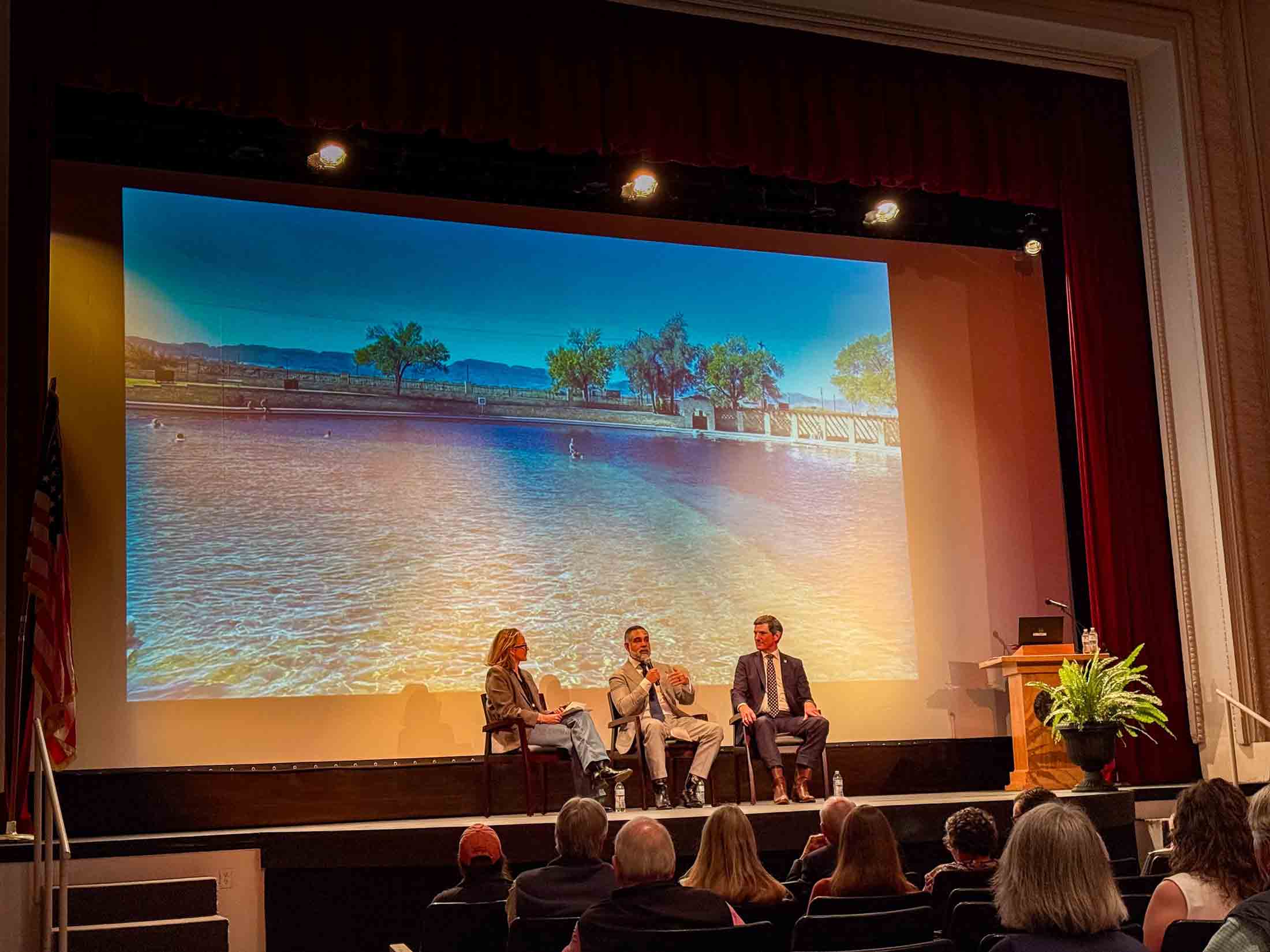
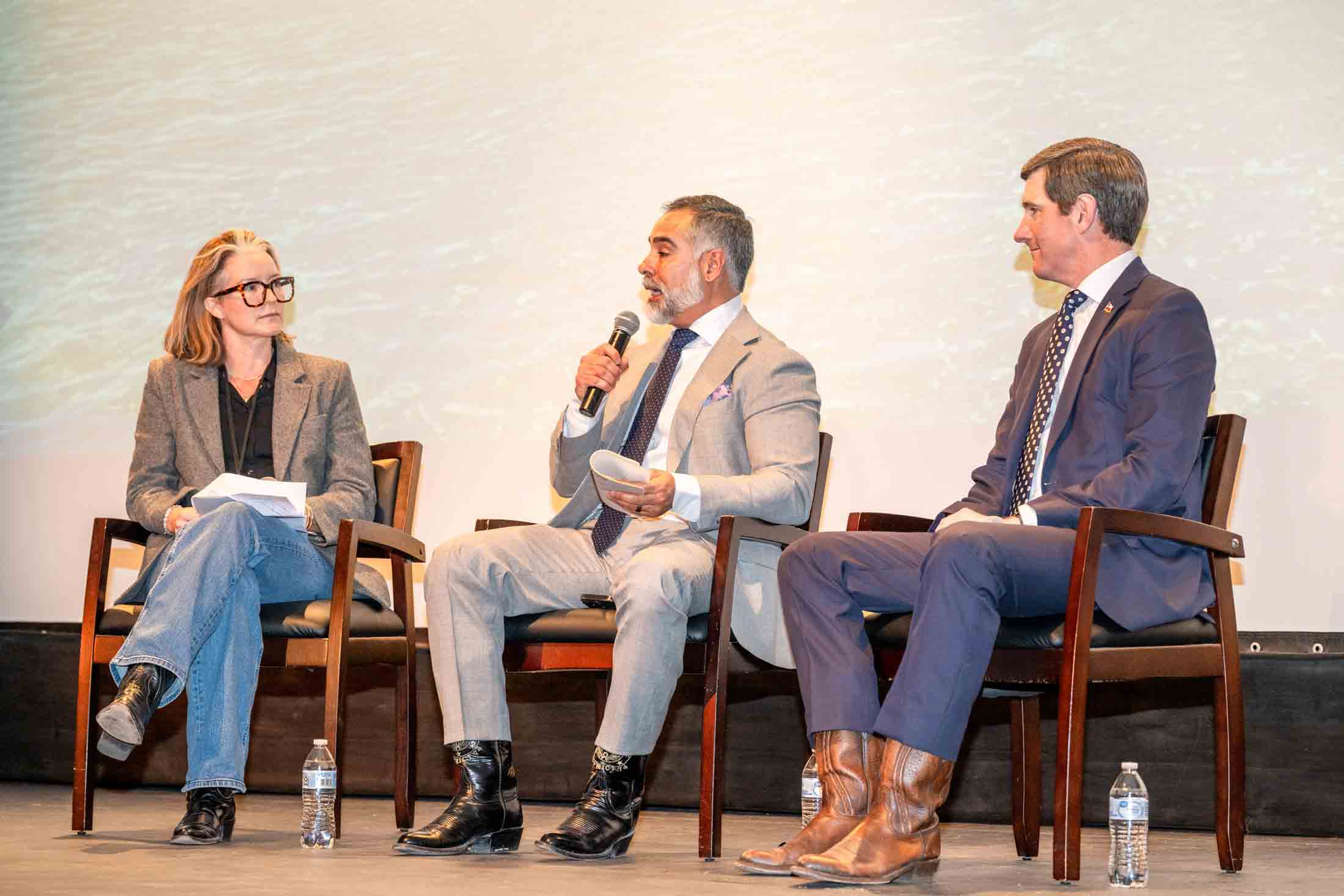
Two West Texas legislators offered a candid look at water policy during a conversation about the challenges facing rural communities and the role the Texas Legislature plays in shaping the state’s water future.
State Representatives Eddie Morales and Brooks Landgraf joined moderator Vanessa Puig-Williams of the Environmental Defense Fund for a discussion that touched on groundwater, infrastructure, economic growth and the importance of collaboration across political lines.
Morales, a Democrat whose House District 74 stretches from Eagle Pass to far West Texas, began by describing the enormous geographic scope of the district he represents.
“House District 74… goes all the way to the far east side of El Paso. It’s the largest district not only in Texas, but in the entire United States,” Morales said.
Despite representing communities hundreds of miles apart, he said water is a shared concern across the region.
Morales emphasized that solving water challenges requires cooperation rather than political division.
“If you know how to count, you know you need 76 votes for anything to pass out of the House,” he said. “It is pivotal… that we must reach across the aisle.”
Landgraf, a Republican from Odessa who represents House District 81 and serves as chair of the House Environmental Regulation Committee, echoed that message.
Puig-Williams noted that water policy often brings lawmakers together despite political differences.
“When I pulled up to campus today and saw how many cars were in the parking lot and how many people were in this auditorium, it really warmed my heart,” Landgraf said. “We have a vested population here in West Texas… concerned citizens who want to make sure we’re making the right decisions when it comes to water policy moving forward.”
A Historic Investment
Much of the discussion focused on Proposition 4, a major water funding initiative approved by Texas voters that will provide billions of dollars for water infrastructure and supply projects.
Landgraf described the measure as an important step but cautioned that it will not solve Texas’ water challenges on its own.
“The bad news is that this is not a silver bullet,” Landgraf said. “This is like a first step.”
“We can’t just do this and then forget about it,” he added. “The problem we’re trying to address is closer to a $100 billion problem.”
The $20 billion investment over 20 years is intended to address two major needs: developing new water supplies and repairing aging infrastructure.
About half of the funding will support projects designed to create additional water sources. Landgraf said those could include technologies such as brackish groundwater desalination, seawater desalination or even importing water from other river basins.
“We’re really trying to leave no stone unturned in the quest for water,” he said.
The other half of the funding will focus on repairing aging water systems across the state. Many of Texas’ pipelines and distribution systems were built decades ago.
“Water pipelines have about a 75-year life,” Landgraf said. “A lot of those pipelines have reached the end of their useful lives.”
As those systems deteriorate, communities across Texas are experiencing water main failures and other infrastructure breakdowns.
“The only thing that can fix that is money,” he said.
Rural Challenges
While large cities often have the resources to pursue major water projects, Morales said smaller communities in rural West Texas face additional challenges.
Many towns lack the staff and technical expertise needed to apply for grants or manage large infrastructure projects.
“Many of the cities or local governments that I represent don’t have grant writers,” Morales said. “They don’t have people that have the expertise to even apply for that funding.”
His office has tried to help bridge that gap by providing information and assistance to counties and cities across the district.
“We make sure we provide all 11 counties with information with respect to grant funding,” Morales said.
Even so, he said smaller communities often struggle to compete with larger cities that have dedicated teams focused on securing state funding.
“When you’re competing with some of these huge cities… you’re that far back,” Morales said.
Groundwater Concerns
The conversation also turned to groundwater, which supplies much of the water used across West Texas.
Morales said ranchers and farmers must remain the top priority when decisions are made about how groundwater resources are managed.
“Cattle and ranching and farming should be our top priority, especially out here in West Texas,” he said.
He expressed concern about proposals that would export groundwater from rural counties to other parts of the state.
“If you cannot even provide the basics for those cattlemen or those farmers, why are you even considering going out and distributing your water somewhere else?” Morales said.
Landgraf offered a personal perspective shaped by his experience growing up in a ranching family.
“We rely almost exclusively on groundwater,” he said.
Over time, he has seen water availability decline on the family ranch as wells have produced less water and deeper wells have been required.
“My entire adult life… the quantity of water at our ranch has consistently dropped,” Landgraf said.
That experience, he said, highlights the importance of understanding the state’s groundwater resources more clearly.
“We’re talking about water policy in an environment where we don’t always have the full picture,” Landgraf said. “Having that kind of data is absolutely essential to making good and sound policy.”
Without better information, he added, policymakers risk making decisions without fully understanding the consequences.
“If we don’t know that picture, then we’ve got blinders on,” he said.
New Issues on the Horizon
Both legislators said the state must also prepare for emerging water challenges tied to economic growth and energy development.
Landgraf pointed to “produced water” from oil and gas operations in the Permian Basin as both a challenge and a potential opportunity.
Produced water is generated during oil and gas drilling and often contains contaminants that require treatment. Much of it is currently disposed of by reinjection underground.
“Produced water is a burden and a blessing if we do it the right way,” Landgraf said.
If properly treated, he said, the water could potentially be used for certain industrial purposes, reducing pressure on freshwater resources.
Morales agreed that the oil and gas industry plays an essential role in the state economy but said it must also help address environmental impacts associated with energy production.
“As a friend of the industry, I think it’s imperative for us to provide constructive criticism,” Morales said. “They also create a lot of the messes that we’re dealing with.”
Looking Ahead
Both lawmakers said collaboration between legislators, scientists and local communities will be essential as Texas works to address long-term water challenges.
Landgraf said the state is beginning to make progress in gathering better information and coordinating water planning across different agencies and groundwater districts.
“Having that kind of data is absolutely essential to making good and sound policy,” he said.
Morales emphasized that solving water challenges will require continued cooperation across political parties and regions of the state.
“This is just the start,” Landgraf said of the state’s recent water investments.
For West Texas communities facing growing demand and uncertain water supplies, he added, the work ahead will require continued collaboration — and sustained attention from state leaders.
Sponsors and Organizing Partners
This conference session excerpt is from Water in the Desert 2026.
Water in the Desert 2026 was hosted and organized by the Meadows Research Institute for West Texas Water at Sul Ross State University.
The conference was made possible through the generous financial support of its major sponsors — Horizon Foundation, Dixon Water Foundation, and Reeves County Groundwater Conservation District — whose leadership investment ensured the event remained accessible and affordable to attendees from across the region.
Additional sponsors included Brewster County Groundwater Conservation District, Environmental Defense Fund, EHT–Enprotec Hibbs & Todd, Frontier Development Inc., Rio Grande Joint Venture, Texas Wildlife Association, and The Nature Conservancy.
The quality and depth of the program were shaped by a collaborative team of organizing partners, including Sul Ross State University, Borderlands Research Institute, Environmental Defense Fund, Rio Grande Joint Venture, Texas Water Foundation, Texas Agricultural Land Trust, Dixon Water Foundation, Texas Wildlife Association, The Nature Conservancy, Texas Parks and Wildlife Department, and Texas Parks and Wildlife Foundation.