Data centers are rapidly becoming part of the water conversation in Texas.
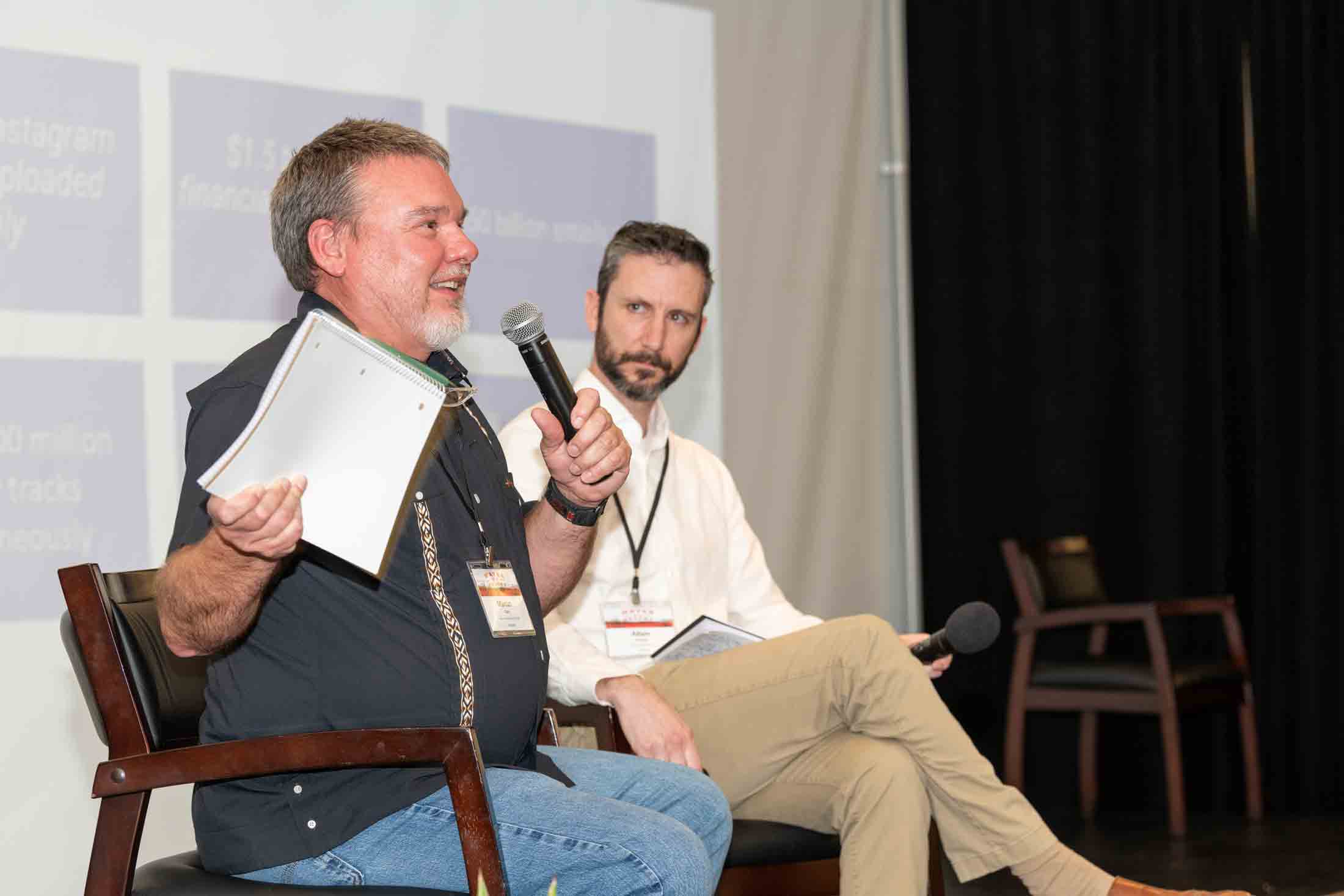
During the final session of the day, hydrogeologist Dr. Marcus Gary of the Bureau of Economic Geology and water infrastructure consultant Adam Conner explored what the expanding digital infrastructure behind artificial intelligence, cloud computing and online commerce could mean for water use in West Texas.
The issue is emerging quickly.
Across the United States, roughly 40 percent of the world’s data centers are located domestically, Gary said. Texas alone accounts for about 10 percent of those facilities, placing the state squarely in the center of a rapidly growing industry.
“Zoom in even more,” he said, “and West Texas is being targeted pretty heavily because of the energy resources that exist out here.”
Recent announcements of planned facilities in Pecos, Presidio and El Paso illustrate that trend.
At the same time, Gary noted, the public conversation around data centers is still developing. While communities may hear about new projects in the news, many people remain unfamiliar with how the facilities operate and what resources they require.
A Growing Digital Infrastructure
Gary opened his remarks with a simple show of hands from the audience.
“How many of you use smartphones?” he asked. “How many of you use Google? Does anybody shop on Amazon?”
Nearly every hand in the room went up.
The exercise underscored a larger point: modern life depends heavily on data infrastructure. Everything from online purchases to conference registrations relies on vast networks of servers storing and processing information.
“Our society has evolved to the point where we are dependent on big data,” Gary said.
Those servers generate significant heat, requiring sophisticated cooling systems. Electricity generation also plays a major role, meaning water use occurs both directly and indirectly.
“The indirect use of water is the water that’s used in power generation,” Gary explained, while “the direct use is what’s used for cooling.”
Understanding those two pathways is key to evaluating potential impacts.
Where Data Centers Are Likely to Locate
Gary described research underway at the Bureau of Economic Geology’s Compass group, which has been examining how companies choose locations for new data centers.
Researchers consider multiple factors, including energy availability, fiber optic infrastructure, labor force, and environmental hazards.
One factor that has only recently begun receiving more attention is water.
“The water issue is really just starting to come to a head,” Gary said, noting that policymakers are increasingly recognizing the need to consider water availability alongside energy and infrastructure.
Not all data centers use water in the same way, he emphasized.
Some employ closed-loop cooling systems that recycle water. Others rely more heavily on air cooling or alternative technologies. Facility size, cooling systems and power generation sources can all influence water demand.
“Not all data centers are the same,” Gary said. “There are different sizes. They use different technologies to cool.”
Because of that variability, estimating water demand without knowing the specific design of a facility can be difficult.
Understanding Water Demand
Conner expanded on that point with a diagram illustrating the different ways water may be used in data center operations.
Cooling computer chips represents the largest direct demand, but water may also be used in power generation depending on the energy source supplying electricity.
“There’s cooling of the servers, moving the heat out of the building, and then there’s water related to generating that power,” he said.
The amount of water involved can vary widely.
“I’m sorry — I’m not going to be able to give you a number of how much water a data center uses,” Conner said. “It’s really dependent.”
That uncertainty has left many local water utilities seeking better information.
Conner said utilities increasingly ask how potential data centers might affect long-term water planning.
“A lot of them have been coming to me and saying, ‘How much water is this data center going to need in the future?’” he said.
Questions Communities Should Ask
Because water demand can vary so widely, Conner encouraged communities to ask detailed questions early in the development process.
Among the most important: where the facility plans to obtain its water supply.
Surface water rights are largely allocated across Texas, he noted, meaning new industrial projects often turn to groundwater.
In areas governed by groundwater conservation districts, data centers must follow the same permitting processes as other large water users.
But in “white areas” of the state — counties without groundwater districts — there may be fewer regulatory checks.
“These are counties that don’t have groundwater conservation districts,” Conner said. “There’s not a layer of checks and balances to really restrict someone from putting in a well and pumping a lot of water out.”
That makes local awareness and engagement especially important.
He also suggested communities explore alternative sources, including recycled water or produced water, as potential supplies for data center operations.
Policy Still Catching Up
Both speakers noted that policymakers are still working to understand how best to plan for the industry.
State agencies including the Public Utility Commission and Texas Water Development Board have begun coordinating efforts to gather information and evaluate potential impacts.
But the pace of development is rapid.
“This is new to everybody,” Conner said. “This is something the state of Texas is having to learn on the fly.”
Finding Opportunities
Gary closed by encouraging communities to stay engaged as projects emerge.
Data centers are likely to continue expanding as demand for digital services grows, he said. The question is how communities respond.
In some cases, development could create opportunities to invest in water infrastructure or reuse systems. But those outcomes depend on early engagement and informed negotiation.
“We all know that our society is going to require these types of facilities,” Gary said. “So how do we deal with that? Is there a way that we can pull some positive out of it?”
For West Texas communities already navigating water scarcity, the arrival of data centers adds another layer to the region’s complex water landscape.
How that story unfolds, the speakers suggested, will depend largely on how communities, regulators and industry work together in the years ahead.
Sponsors and Organizing Partners
This conference session excerpt is from Water in the Desert 2026.
Water in the Desert 2026 was hosted and organized by the Meadows Research Institute for West Texas Water at Sul Ross State University.
The conference was made possible through the generous financial support of its major sponsors — Horizon Foundation, Dixon Water Foundation, and Reeves County Groundwater Conservation District — whose leadership investment ensured the event remained accessible and affordable to attendees from across the region.
Additional sponsors included Brewster County Groundwater Conservation District, Environmental Defense Fund, EHT–Enprotec Hibbs & Todd, Frontier Development Inc., Rio Grande Joint Venture, Texas Wildlife Association, and The Nature Conservancy.
The quality and depth of the program were shaped by a collaborative team of organizing partners, including Sul Ross State University, Borderlands Research Institute, Environmental Defense Fund, Rio Grande Joint Venture, Texas Water Foundation, Texas Agricultural Land Trust, Dixon Water Foundation, Texas Wildlife Association, The Nature Conservancy, Texas Parks and Wildlife Department, and Texas Parks and Wildlife Foundation.