A recent Nature Notes story from Marfa Public Radio takes listeners beneath the surface of West Texas to explore the complex aquifers that sustain communities, springs and wildlife across the region.
Reporter Andrew Stuart interviewed Sul Ross State University geologist Dr. Jesse Kelsch about her work to better understand the groundwater systems that feed San Solomon Springs, the Igneous Aquifer and the Santa Elena Aquifer. The story also highlights the newly launched San Solomon Springs Collaborative, housed at the Meadows Research Institute for West Texas Water.
Kelsch and her colleagues are working to answer critical questions about where the region’s groundwater comes from, how it moves and where recharge occurs. The answers could help guide future conservation and water management efforts across Far West Texas.
We appreciate Marfa Public Radio for shining a light on this important research and the people working to better understand one of West Texas’ most valuable resources.
In the heart of the Chihuahuan Desert, a network of springs has sustained life for thousands of years.
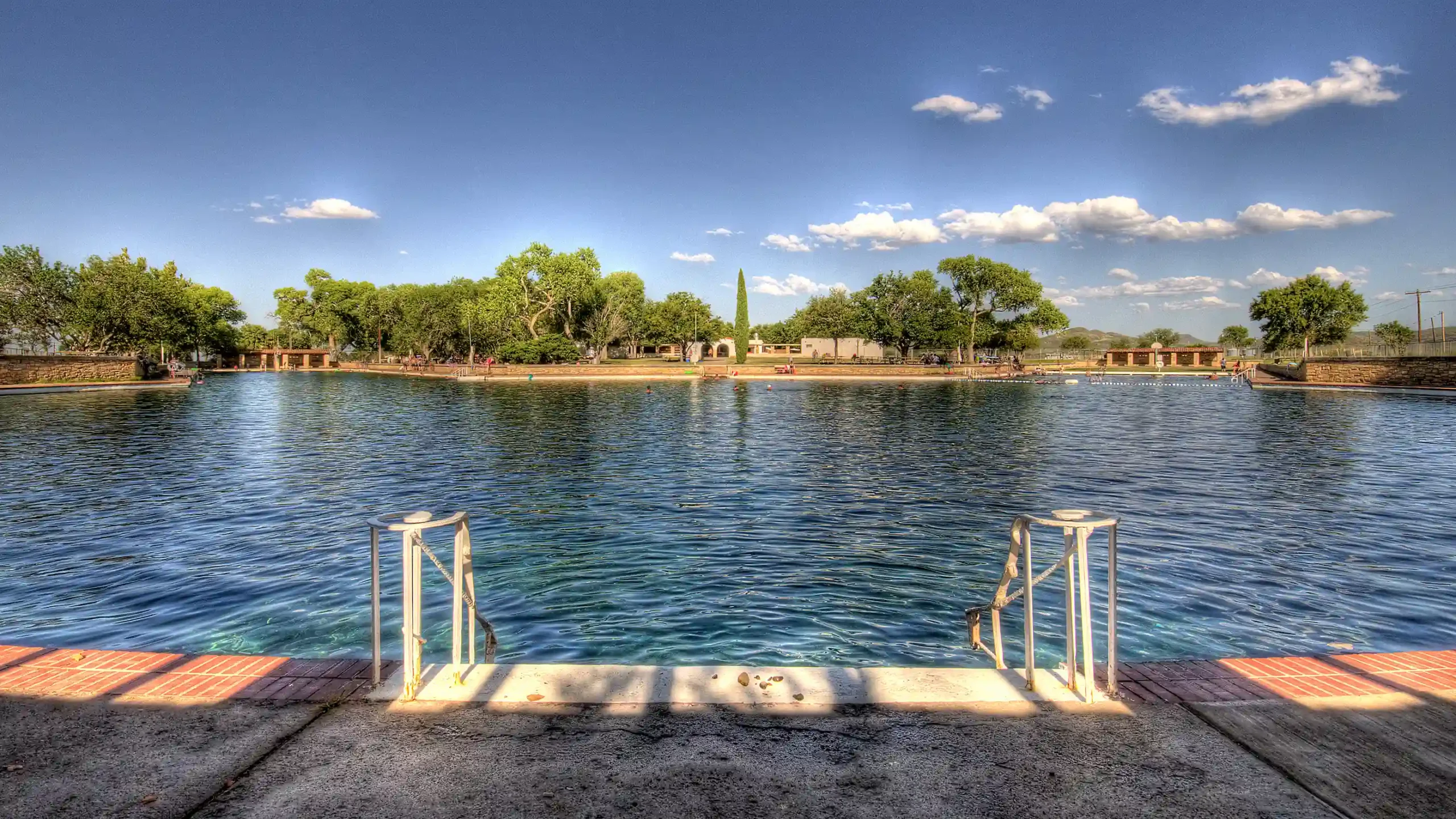
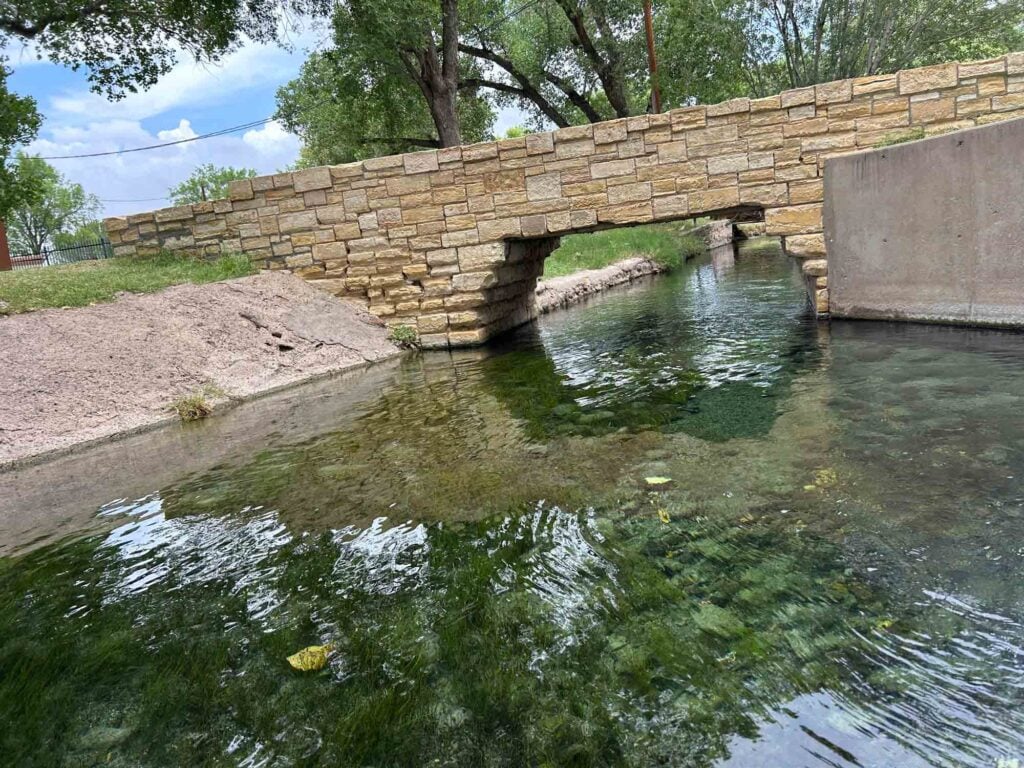
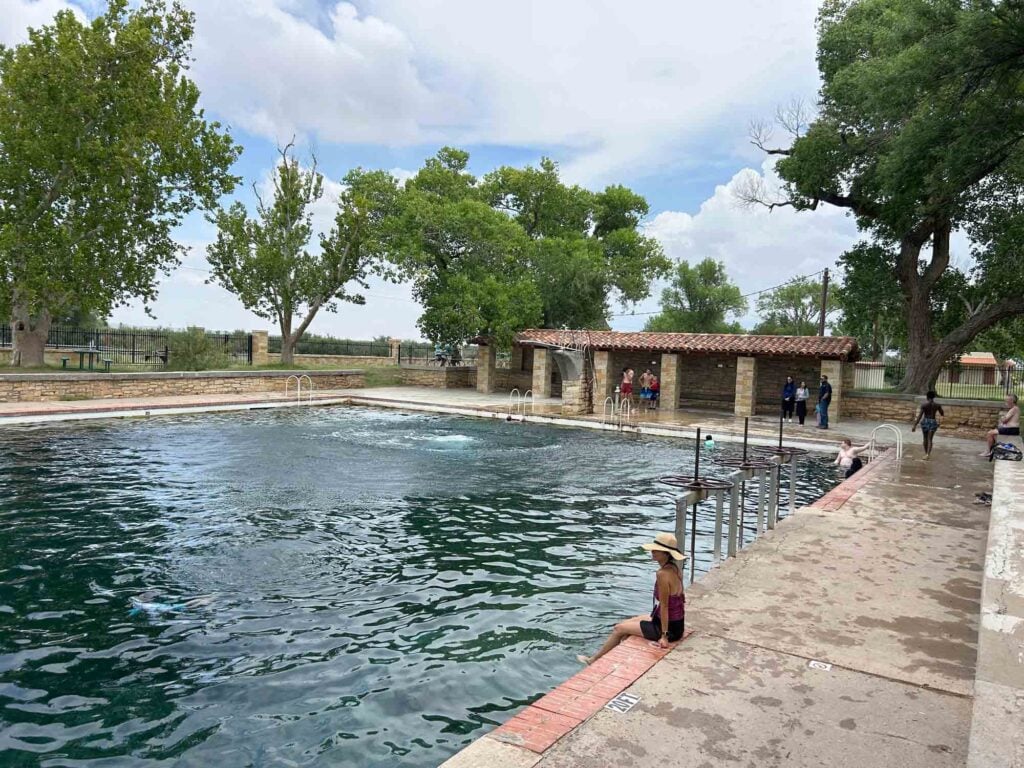
San Solomon Springs, the largest of six artesian springs near Balmorhea, feeds the world-famous pool at Balmorhea State Park, supports rare desert wildlife and serves as a vital source of water in one of the driest regions of Texas. Millions of gallons of water flow through the springs each day, creating an oasis that has shaped the region’s ecology, economy and culture for generations.
Now, a growing coalition of researchers, landowners, community leaders and conservation partners is working to ensure those springs continue flowing well into the future.
The San Solomon Springs Collaborative, housed at the Meadows Research Institute for West Texas Water at Sul Ross State University, was created to advance research, strengthen community engagement and build a shared understanding of the groundwater systems that sustain the springs.
The effort comes at a pivotal moment.
Across Texas, roughly 30 percent of springs have disappeared completely and the rate of springs that are going dry has increased in recent decades. Among those that remain, San Solomon Springs is considered one of the most significant desert spring systems in the state. Yet scientists have documented a long-term decline in spring flows. Phantom Spring, located at a higher elevation within the same regional system, has already stopped flowing entirely.
Researchers know that water reaching Balmorhea originates from precipitation falling in the Apache and Davis mountains and moves through complex underground pathways before emerging at the springs. But many questions remain unanswered.
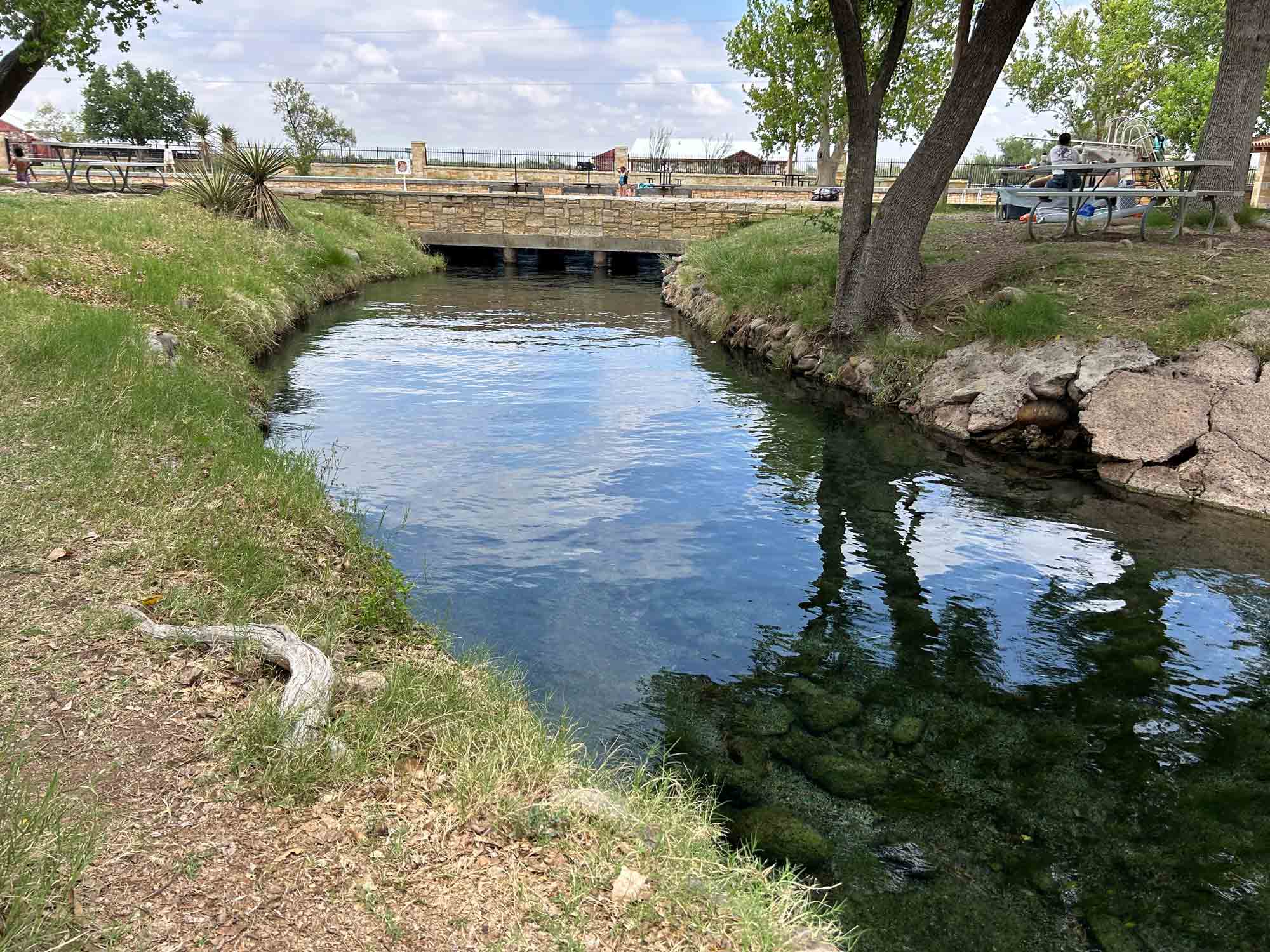
San Solomon Springs, the largest of six artesian springs near Balmorhea
Where does the water recharge? How long does it remain underground? What pathways does it follow before reaching the springs? And what can be done to ensure the system remains healthy for future generations?
Those are the questions driving the collaborative.
“We don’t know the big picture yet, which has been the biggest unanswered thing,” said Dr. Kelbi DeLaune, assistant professor of natural sciences and research scientist with the Meadows Research Institute. “What we’re trying to do is establish not only a groundwater monitoring network, but a landowner and stakeholder collaborative focused on protecting spring flow.”
The initiative brings together a diverse group of partners, including local groundwater conservation districts, farmers, ranchers, community members and conservation organizations. The collaborative seeks to advance science while building trust among those who live and work in the region.
That relationship-building component is every bit as important as the research itself.
“Everybody wants to see those springs flowing,” DeLaune said. “It’s a nonpartisan issue.”
The collaborative is exploring ways to expand groundwater monitoring throughout the springshed while respecting landowner privacy and ensuring data is used responsibly. By improving understanding of groundwater movement and aquifer conditions, researchers hope to provide information that can help guide future stewardship efforts.
The work aligns closely with the mission of the Meadows Research Institute for West Texas Water, which was established to advance applied research, education and technical assistance related to water resources across the Trans-Pecos.
The San Solomon Springs system is also receiving increased national recognition.
Earlier this year, the site was designated a National Geoheritage Area, recognizing its exceptional geological, ecological and cultural significance. The designation highlights the springs as one of the nation’s important natural landscapes and underscores the value of protecting the resources that sustain them.
Long before she became a scientist, she first visited the region as a college student participating in field research. Nearly two decades later, she still returns to the same waters that inspired her career.
“These springs really were everything about my science identity and what it means to love nature and understand the culture and the people that use these resources,” she said.
Over the years, she has witnessed firsthand how closely connected the community is to the springs. When water levels decline or facilities close temporarily, the impacts ripple throughout the region.
San Solomon Springs feeds the world-famous pool at Balmorhea State Park.
“When the pool closed for repairs for almost two years in 2019, the economy here sank, the overall community morale changed,” DeLaune said. “It has closed off and on for various reasons since then, and it impacts the community every time. These springs are deeply ingrained in us.”
That connection gives her hope.
She points to growing public interest in water issues, stronger partnerships among stakeholders and the conversations sparked by events such as the recent Water in the Desert conference as evidence that attitudes are changing.
“People are talking about water differently than they used to,” she said. “We’re talking about it from economics, from culture, from future generations and from being good stewards of the land.”
Ultimately, she believes the springs serve as a reminder of just how connected West Texans are to the resource that sustains them.
“These springs and these systems are really what allow us to exist,” DeLaune said. “If they don’t exist, we can’t exist.”
As the San Solomon Springs Collaborative continues to grow, organizers hope the effort will deepen scientific understanding, strengthen community partnerships and build lasting support for one of Texas’ most remarkable desert landscapes.
After all, protecting the future of San Solomon Springs means protecting the future of the communities, wildlife and landscapes that depend on them.
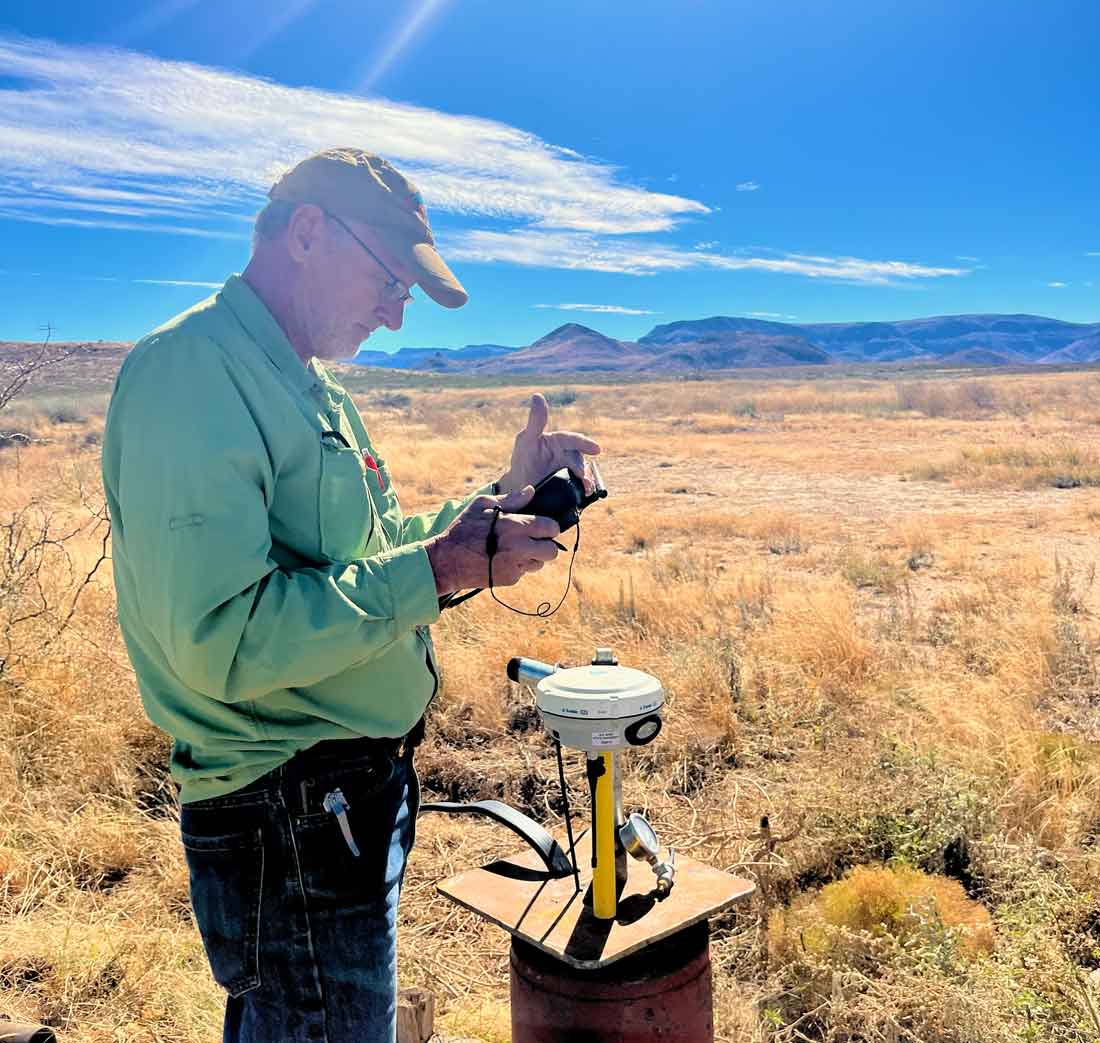
Dr. Kevin Urbanczyk conducts groundwater monitoring field work.
Water may be the most important resource in West Texas, but much of it remains hidden from view.
Beneath the ranchlands, mountains and desert valleys of the Trans-Pecos, groundwater moves through a complex network of aquifers, fractures and underground pathways. Understanding where that water comes from, how it moves and how it changes over time is essential to protecting springs, sustaining communities and informing future water management decisions.
That’s why the Meadows Research Institute for West Texas Water is working to expand a regional groundwater monitoring network across Far West Texas.
The effort builds on decades of groundwater research led by Sul Ross State University scientists and includes monitoring wells in Brewster and Presidio counties, as well as new monitoring efforts associated with the San Solomon Springs Collaborative near Balmorhea. The goal is straightforward: collect long-term groundwater data that can help answer some of the region’s most important water questions.
“Much of what we’re trying to do is simply understand the system better,” said Dr. Kevin Urbanczyk, senior research scientist at the Meadows Research Institute and professor of geology at Sul Ross State University.
One of the institute’s highest priorities is understanding the groundwater system that feeds San Solomon Springs. Scientists know that much of the water originates west of Balmorhea, likely in the vicinity of Van Horn and the Apache Mountains, but important questions remain about the specific pathways the water follows underground before emerging at the springs.
“We have a very clear idea that much of it is coming from the west,” Urbanczyk said. “But specifically, the path isn’t exactly clear. That’s what we’re looking for.”
To help answer those questions, researchers are working with landowners to identify strategically located wells where groundwater levels can be monitored over time. Participation is voluntary, and landowners receive information about groundwater conditions on their property as well as regional groundwater trends.
The monitoring effort may also include real-time telemetry systems that allow water levels to be tracked continuously.
The monitoring network is about more than San Solomon Springs. Over the past several years, Urbanczyk and his collaborators have expanded monitoring efforts across Presidio County, building a network of more than 20 monitored wells that provide valuable information about long-term groundwater trends. That information has already helped groundwater conservation districts make more informed decisions about future water management.
The work also supports one of the key priorities identified in the Meadows Research Institute’s strategic plan: expanding groundwater monitoring to improve understanding of aquifer conditions, groundwater flow paths and regional water availability. The institute envisions monitoring data playing an important role in future research, educational programs and technical assistance efforts throughout the region.
The goal, Urbanczyk said, is to build a clearer picture of how groundwater moves across the region.
“We want to understand the system,” he said. “The more information we have, the better equipped we’ll be to answer important questions about West Texas water.”
That understanding could help answer longstanding questions about groundwater movement, identify recharge areas, improve water planning efforts and provide landowners and communities with better tools for stewardship.
As the network expands, the institute is seeking opportunities to work with landowners in strategic locations throughout the region. Participation is voluntary, and landowners receive information about groundwater conditions on their property as well as regional groundwater trends.
The institute continues to identify strategically located wells that can help fill critical gaps in researchers’ understanding of West Texas groundwater systems. Landowners interested in learning more about the groundwater monitoring network are encouraged to contact Urbanczyk at kevinu@sulross.edu.
As the monitoring network grows, so too will the region’s ability to understand one of its most valuable and least visible natural resources.
The water may be underground, but its future affects everyone who calls West Texas home.
The Meadows Research Institute for West Texas Water is building something big, and we’re growing the team to match.
Following a landmark launch supported by a $2.75 million commitment from The Meadows Foundation, the institute is expanding its capacity to advance real-world water solutions across Far West Texas.
Now, we’re inviting bold, collaborative leaders to help take the next step.
Two New Positions Now Open
We are currently hiring for two key roles that will help shape our trajectory from the ground up:
Director, Meadows Research Institute for West Texas Water This is a rare opportunity to lead a new, mission-driven institute focused on one of the most pressing challenges of our time. The Director will serve as the Institute’s primary ambassador, guiding strategy, building partnerships, advancing research and securing the resources needed to grow a world-class program rooted in the Trans-Pecos.
This role calls for a seasoned leader with deep experience in water or natural resources, and a vision for connecting science, education and community impact.
Administrative Coordinator Behind every successful initiative is a strong operational backbone. This position will support day-to-day functions, coordinate communications and logistics, and help ensure the Institute’s work runs smoothly as it scales.
Together, these roles will help build the foundation for a high-impact organization designed to serve communities, landowners, and water managers across the region.
Why This Work Matters
Water in Far West Texas is scarce, complex, and essential. From groundwater-dependent communities to iconic desert springs, the challenges are real and growing.
The Meadows Research Institute for West Texas Water was created to meet this moment by advancing applied research, developing the next generation of water professionals, and delivering technical support where it’s needed most.
But just as important as the work itself is how it gets done. Collaboration, partnership, and a deep connection to place are at the core of the Meadows Research Institute’s approach.
“The Meadows Research Institute was created for the region and with the region,” said Billy Tarrant, who is serving as interim director. “As we build this team, we’re looking for people who want to roll up their sleeves, work alongside communities, and help deliver real-world solutions that matter for West Texas.”
Be Part of What Comes Next
The momentum is building, from the success of the recent Water in the Desert conference to the development of new programs, partnerships and research initiatives.
Now is the moment to get involved.
If you’re ready to help shape the future of water in one of the most dynamic and challenging landscapes in Texas, we encourage you to explore these opportunities and apply.
For three days in February, Alpine became the center of one of the most important water conversations in Texas.
Landowners, scientists, groundwater conservation district leaders, legislators, judges, nonprofit partners and community members gathered at Sul Ross State University for Water in the Desert 2026, the first major event hosted by the newly launched Meadows Research Institute for West Texas Water.
But this moment did not happen overnight.
Two years ago, when the Borderlands Research Institute convened the first Water in the Desert conference, organizers made a promise.
“We made a promise — to the community, to our stakeholders, to our students, to our funders — that we would do something special,” said Dr. Louis Harveson, director of the Borderlands Research Institute and associate provost for research and development at Sul Ross State University.
Over the next two years, that promise took shape. A steering committee was formed. A strategic plan was developed. Partnerships deepened. Funders stepped forward.
On January 1, 2026, the Meadows Research Institute for West Texas Water officially launched. Incubated at the Borderlands Research Institute and built on decades of trusted relationships across the Trans-Pecos, the new Institute now has a permanent home and clear direction.
“This is really their launch,” Harveson said, gesturing to the Institute’s science and administrative team during the conference. “Water in the Desert 2026 is the inauguration of this new research institute at Sul Ross.”
Science First
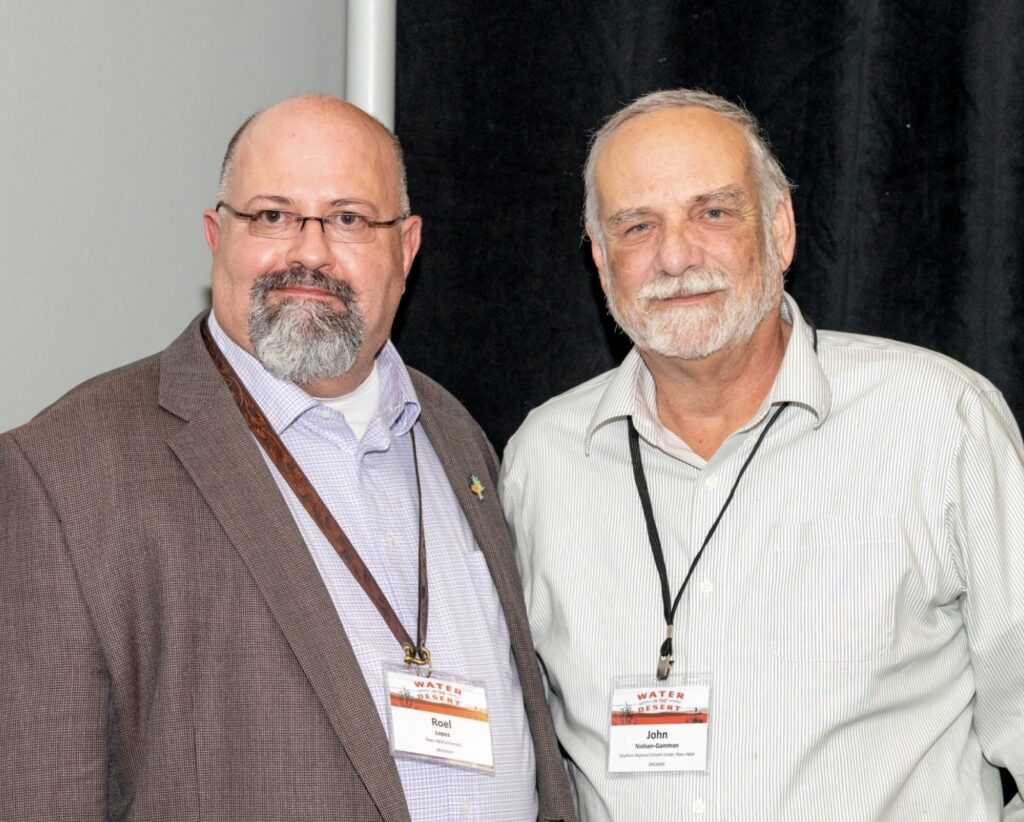
At Water in the Desert 2026, Dr. Roel Lopez (left) of Texas A&M University set the stage with an overview of land trends in the Trans-Pecos, which remains defined by large, intact working landscapes. State Climatologist Dr. John Nielsen-Gammon (right) provided a clear-eyed assessment of climate realities showing that planning for water in West Texas requires better data and adaptive management. (Brenda Ladd Photography)
The conference opened on February 11 by grounding the conversation in data.
Dr. Roel Lopez of Texas A&M University set the stage with an overview of land trends in the Trans-Pecos, underscoring what makes this region distinct. Unlike much of Texas, where land fragmentation is accelerating, the Trans-Pecos remains defined by large, intact working landscapes. That scale offers a critical advantage for long-term conservation and water stewardship.
State Climatologist Dr. John Nielsen-Gammon followed with a clear-eyed assessment of climate realities. Temperatures are rising. Droughts are getting hotter. While precipitation trends are complex, the takeaway was unmistakable: planning for water in West Texas requires better data and adaptive management.
That theme carried into legislative discussions.
“Having that kind of data is absolutely essential to making good, sound policy,” said State Representative Brooks Landgraf. “If we don’t know the picture that we’ve got, we’re operating blind.”
Improved coordination among groundwater conservation districts and stronger data sharing with the Texas Water Development Board emerged as priorities from the 2025 legislative session.
A Landowner’s Perspective
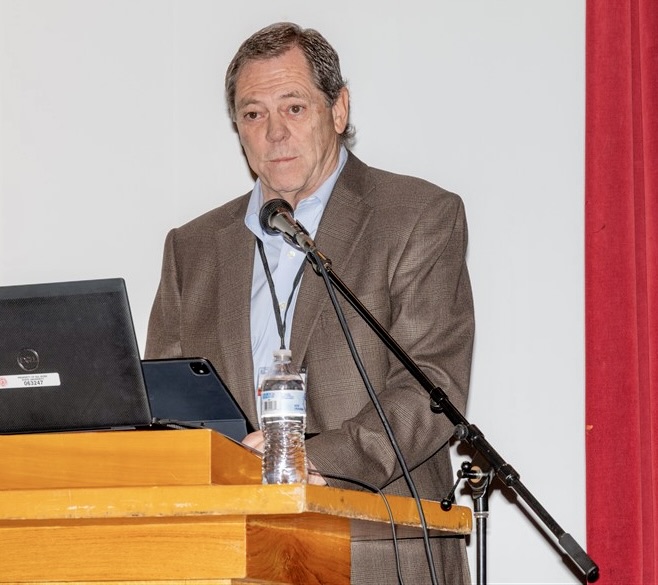
Texas Parks and Wildlife Commission Chairman Paul Foster underscored both the complexity of West Texas water systems and the responsibility that comes with land stewardship in his opening remarks at Water in the Desert 2026. (Brenda Ladd Photography)
Texas Parks and Wildlife Commission Chairman Paul Foster offered remarks to open the program on February 12 that underscored both the complexity of West Texas water systems and the responsibility that comes with land stewardship.
Speaking as a West Texas landowner, Foster described commissioning groundwater studies on his own ranches to better understand how springs and aquifers are interconnected across county lines.
“Water doesn’t respect ownership the way we might like it to,” Foster said. “It moves, it connects, it disappears — and decisions made in one place can have significant consequences somewhere else.”
He noted that some groundwater beneath his ranch dates back tens of thousands of years — a reminder that today’s management decisions carry generational implications.
“If you think about that,” he said, “the decisions we make about water today have very long impacts.”
Although studies suggested significant quantities of groundwater could potentially be produced from his property, Foster said he ultimately chose not to pursue commercial development.
“As the owner of 55,000 acres of West Texas ranchland, I have a responsibility not only to my neighbors, but to the future,” he said.
Foster also praised the collaborative approach represented by the conference and the newly launched Institute.
“You’re choosing data over guesswork and long-term thinking over short-term fixes,” he told attendees. “That’s rare — and it’s impressive.”
Historic Investment and Realism
A major focus of the conference was Proposition 4, the $20 billion, 20-year investment in Texas water infrastructure and supply.
State Representative Eddie Morales called it historic and necessary.
“This is not a silver bullet,” Morales said. “It’s a first step.”
He emphasized the importance of ensuring rural communities can access funding, particularly those without grant writers or technical capacity.
Water infrastructure failures, aging pipes, limited treatment systems and shrinking aquifers are not abstract issues in West Texas. They affect ranching operations, municipal growth and public health. And groundwater remains central.
“If you can’t provide the basics for your own cattlemen and farmers,” Morales noted, “why are you considering exporting water somewhere else?”
In a region where working lands and water security are inseparable, stewardship must remain local and informed by science.
Produced Water and Practical Solutions
Vanessa Puig-Williams of the Environmental Defense Fund moderated a legislative session at Water in the Desert 2026. State Rep. Brooks Landgraf, chair of the House Environmental Regulations Committee, and Rep. Eddie Morales discussed statewide water policy opportunities. The message from the lawmakers was consistent: Innovation must be paired with accountability. (Brenda Ladd Photography)
The conversation also turned to produced water in the Permian Basin, a growing challenge and potential opportunity.
Landgraf described it as “both a burden and a blessing, if we do it the right way.”
Legislation passed in 2025 transferred certain permitting authority for land application of treated produced water to the Texas Commission on Environmental Quality, aligning oversight with water expertise. The goal is to explore beneficial reuse options while preventing environmental harm.
The message from lawmakers was consistent: Innovation must be paired with accountability.
Philanthropy and a Full-Circle Moment
For Eric Meadows, president and CEO of The Meadows Foundation, the conference marked more than a milestone. It represented a continuation of a long-term commitment to water in Texas.
Two years ago, leaders from The Meadows Foundation attended the inaugural Water in the Desert conference. What they heard were grounded conversations about aquifers, infrastructure, land stewardship and the future of rural communities.
“It was really through those conversations,” Meadows said, “that we started learning about some of the needs and felt there was a real opportunity to make a difference.”
The Meadows Foundation had already stepped into Texas water in 2012 with the establishment of the Meadows Center for Water and the Environment at Texas State University. The vision taking shape in Alpine felt like a natural next chapter, a complementary investment focused specifically on Far West Texas.
“This was the follow-up to that opportunity,” Meadows explained.
The result is the Meadows Research Institute for West Texas Water, formally launched January 1 and supported by a $2.5 million endowment and $250,000 in multiyear operational funding from The Meadows Foundation, along with additional philanthropic partners.
Looking out at the packed auditorium, Meadows offered a simple but powerful affirmation.
“You’ve got something really good going on,” he said. “I feel like West Texas water is going to unify.”
The Meadows Research Institute’s mission to advance collaborative water solutions through applied research, education and technical expertise now has both structure and sustained support. What began as a promise in 2024 has become a funded, mission-driven platform designed to serve the region for decades to come.
Investment and Opportunity
Congressman Tony Gonzales closed the conference with a message that was both personal and pragmatic.
“Water is life — water is important,” he said. “I don’t just view it through the lens of West Texas. I view it through the lens of our world.”
For Gonzales, the future of water in Far West Texas is inseparable from research, and research is inseparable from funding.
“You can’t do research, you can’t accomplish what needs to be done, if there’s no funding involved,” he told the audience.
As a member of the House Appropriations Committee, Gonzales made clear that federal partnership will be essential to sustaining innovation and problem-solving in the region. He encouraged Sul Ross State University and the Meadows Research Institute to compete for federal community project funding, signaling his willingness to champion research initiatives emerging from Alpine.
“If there’s a project that deals with research,” he said, “there’s a pretty dang good chance I would select it.”
He also expressed confidence that the work belongs here.
“This is the institute to do it,” Gonzales said. “We have the folks that know it, live it, understand it.”
His remarks reinforced a central theme of the conference. West Texas is not asking to be rescued. It is building the expertise and partnerships to lead.
From Promise to Platform
Water in the Desert 2026 was more than a conference.
It was the visible culmination of two years of work led by the Borderlands Research Institute and the public debut of a new, permanent home for West Texas water research.
The Meadows Research Institute for West Texas Water now stands as a regional hub, connecting science to stewardship, policy to practice, and students to the workforce challenges ahead.
The promise made in 2024 has become a platform.
And the work is just beginning.
Sponsors and Organizing Partners
Water in the Desert 2026 was hosted and organized by the Meadows Research Institute for West Texas Water at Sul Ross State University.
The conference was made possible through the generous financial support of its major sponsors — Horizon Foundation, Dixon Water Foundation, and Reeves County Groundwater Conservation District — whose leadership investment ensured the event remained accessible and affordable to attendees from across the region.
Additional sponsors included Brewster County Groundwater Conservation District, Environmental Defense Fund, EHT–Enprotec Hibbs & Todd, Frontier Development Inc., Rio Grande Joint Venture, Texas Wildlife Association, and The Nature Conservancy.
The quality and depth of the program were shaped by a collaborative team of organizing partners, including Sul Ross State University, Borderlands Research Institute, Environmental Defense Fund, Rio Grande Joint Venture, Texas Water Foundation, Texas Agricultural Land Trust, Dixon Water Foundation, Texas Wildlife Association, The Nature Conservancy, Texas Parks and Wildlife Department, and Texas Parks and Wildlife Foundation.