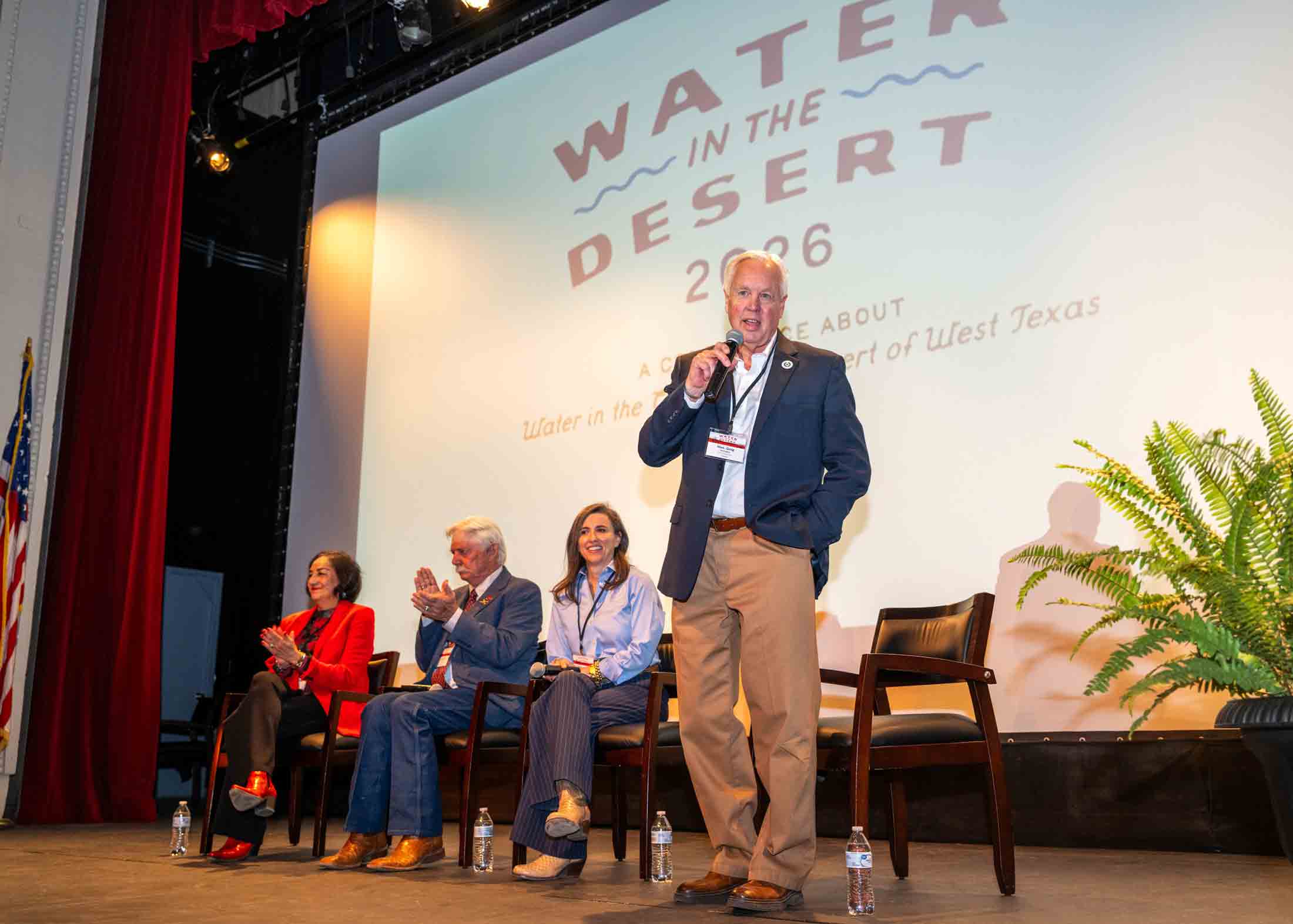
Local County Judges discuss challenges, obstacles and solutions related to water for their communities.
Water in the Desert 2026
Feb. 12 – 1:45 pm Session
Across West Texas, county judges are grappling with the same question: how to manage growth and economic opportunity while protecting the region’s most limited resource — water.
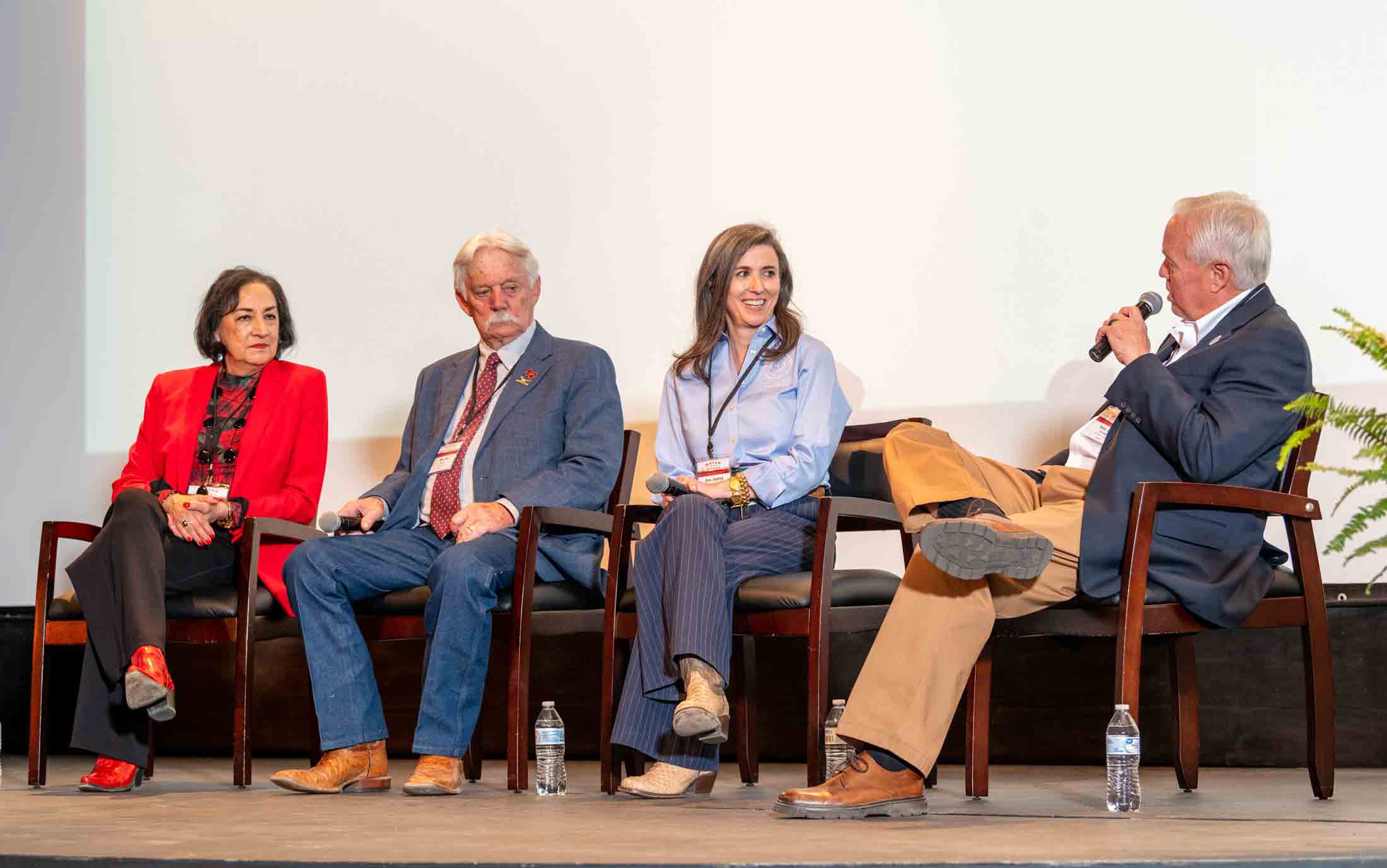
During the “County Voices” panel at Water in the Desert 2026, county judges Greg Henington of Brewster County, Joe Shuster of Pecos County, Joanna Mackenzie of Hudspeth County and Bella Rubio of Real County shared how water challenges are unfolding in their communities and the difficult decisions local officials face as development accelerates across rural Texas.
Henington opened the discussion by noting that county governments are often on the front lines of water issues while having relatively limited regulatory authority.
Each judge brought a perspective shaped by geography and local economic pressures — from the rapidly changing energy corridor of the Trans-Pecos to tourism-driven development and the vast ranchlands of far West Texas.
Rapid change in the Trans-Pecos
In Pecos County, Judge Joe Shuster described how economic development has brought both opportunity and new questions about water use.
Over the past two decades, wind farms and solar projects have become increasingly common across the county’s wide-open landscape. More recently, a new wave of proposals — including artificial intelligence data centers — has raised fresh questions about water demand.
“We’ve had wind farms, we’ve had solar farms,” Shuster said. “Now we’ve got AI data centers coming to Pecos County.”
Some of those projects are still under discussion, but at least one facility is expected to rely on a closed-loop water cooling system.
Shuster said county officials are exploring ways to ensure new developments monitor groundwater impacts as part of their agreements with local authorities.
“We can put in the contract that they drill a monitoring well in the water field that they’re going to take the water out of,” he said.
Pecos County has also relied on negotiated payment-in-lieu-of-tax agreements with energy companies to fund local infrastructure improvements, including restoring aging public buildings and constructing new community facilities.
Despite the pace of change, Shuster said he remains optimistic about the region’s future.
“The future is good,” he said. “It’s going to change just like anything else. We have to learn to adapt and adapt that change to make our living a better place.”
Planning for an uncertain future
In neighboring Hudspeth County, Judge Joanna Mackenzie said the region is facing its own wave of potential development, including proposals tied to rare earth mineral extraction near Sierra Blanca.
The Round Top Mountain area in Hudspeth County contains one of the largest rare earth mineral deposits in the United States — a resource that has attracted increasing national attention.
Mining operations could involve pumping and processing large quantities of water, raising questions about long-term impacts in one of the most arid regions of Texas.
Mackenzie said local leaders are trying to stay engaged as the projects evolve while recognizing the limits of county authority.
“This is happening at a pace that’s hard to describe unless you’re there watching it,” she said.
Her focus, she said, is ensuring the community has a voice in how development unfolds and learning from the experience of other counties.
“My job is to walk alongside it and fight for the right people and the right ideas,” Mackenzie said.
She also brings a personal perspective to the issue. Before becoming county judge, Mackenzie lived on rural property where water access was limited.
“I know what it is to bring every drop of water to my house,” she said. “I know what it’s like to go home and not have water.”
That experience reinforces her view that water planning must look far beyond the next few years.
“I want us to do a five-year plan, a ten-year plan, a twenty-year plan — even a hundred-year plan,” she said.
Tourism growth and water pressures
Real County is confronting a different kind of pressure: growth tied to tourism and second-home development.
Judge Bella Rubio said the county’s scenic rivers — including the Frio and Nueces — draw large numbers of visitors each year.
“Our claim to fame is the Frio River and the Nueces River, and we are very protective of them,” Rubio said.
Over time, Rubio said the county has shifted from a largely ranching-based economy to one increasingly influenced by tourism and recreational property development.
Many long-held ranches have been subdivided as land changes hands and new residents move into the area.
In response, county leaders have tightened subdivision rules in an effort to ensure development does not outpace available water supplies.
Rubio said some developers pushed back strongly against the stricter standards.
“I’ve had developers tell me, ‘If you do that, you’ll never see me develop another piece of property in Real County,’” she said.
But Rubio said protecting water resources ultimately took priority.
“Water is liquid gold,” she said. “It’s something we cannot ever stop protecting.”
Limited authority, growing responsibility
Throughout the discussion, the judges emphasized that county governments often have limited legal authority over water policy. Much of that responsibility lies with groundwater conservation districts, state agencies and the Legislature.
Still, county officials are often the first to feel the impacts of drought, development and changing water demands in their communities.
Shuster said new county judges quickly learn that the job requires navigating complex issues without much formal training.
“There’s not a book in the library that teaches you how to become a county judge,” he said.
Instead, he advised local leaders to seek out expertise and rely on sound information when making decisions that could affect water resources for decades.
“You’ve got to rely on good information, good education and good data,” Shuster said.
For counties across West Texas, those decisions are already underway — as local leaders work to balance economic opportunity with the long-term stewardship of the region’s most precious resource.
Sponsors and Organizing Partners
This conference session excerpt is from Water in the Desert 2026.
Water in the Desert 2026 was hosted and organized by the Meadows Research Institute for West Texas Water at Sul Ross State University.
The conference was made possible through the generous financial support of its major sponsors — Horizon Foundation, Dixon Water Foundation, and Reeves County Groundwater Conservation District — whose leadership investment ensured the event remained accessible and affordable to attendees from across the region.
Additional sponsors included Brewster County Groundwater Conservation District, Environmental Defense Fund, EHT–Enprotec Hibbs & Todd, Frontier Development Inc., Rio Grande Joint Venture, Texas Wildlife Association, and The Nature Conservancy.
The quality and depth of the program were shaped by a collaborative team of organizing partners, including Sul Ross State University, Borderlands Research Institute, Environmental Defense Fund, Rio Grande Joint Venture, Texas Water Foundation, Texas Agricultural Land Trust, Dixon Water Foundation, Texas Wildlife Association, The Nature Conservancy, Texas Parks and Wildlife Department, and Texas Parks and Wildlife Foundation.