Water in the Desert 2026
Feb. 12 – 1:30 pm Session
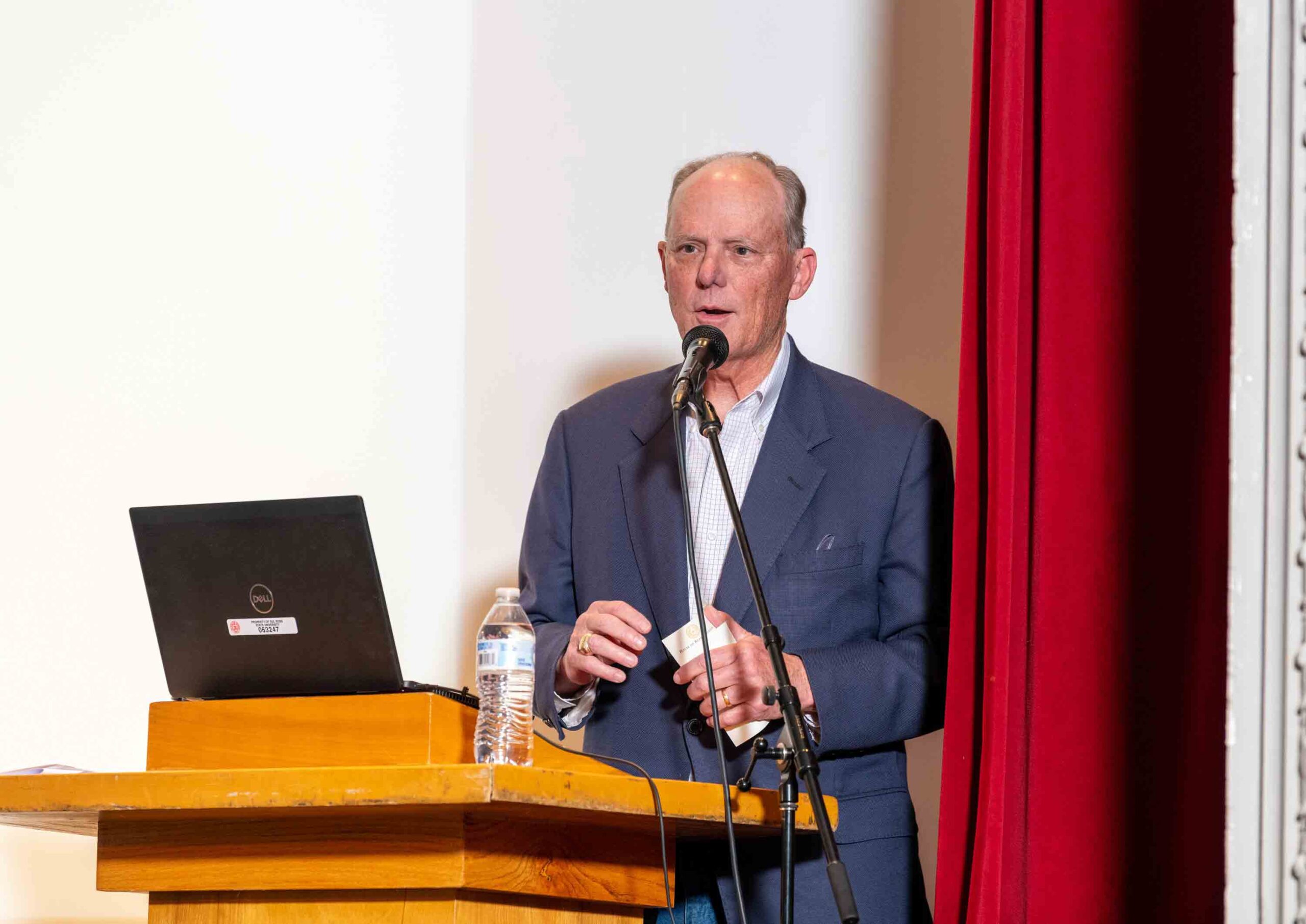
Drawing on nearly three decades in the Texas Legislature, former State Representative Tracy King offered a candid look at how water policy has evolved over time — and why many of the same debates continue today.
King represented House District 80 in South Texas for 28 years, a sprawling district that stretches across ranch country from the Rio Grande north toward Uvalde. During his tenure, he served 14 legislative sessions, including 12 years on the House Natural Resources Committee, where much of the state’s water policy is shaped.
“I had the honor of serving in the Texas House of Representatives for 28 years,” King told the audience. “Fourteen legislative sessions, and 12 of those I served on the Natural Resources Committee — what everybody knows as the water committee.”
During those years, lawmakers wrestled with many of the same issues still shaping water debates today: groundwater management, regional conflicts over water supply and the challenge of balancing local control with statewide policy.
During King’s time in the Legislature, groundwater conservation districts (GCDs) expanded significantly across Texas.
“The Legislature decided that groundwater conservation districts were going to be their chosen method to regulate groundwater,” King said.
Many of those districts were created on a county-by-county basis — a structure that sometimes drew criticism because aquifers often extend across multiple counties and regions.
King said the reason was straightforward.
“It was politics,” he said.
Creating districts that spanned several counties often proved difficult because of the need to secure agreement among multiple local governments and legislators.
“You couldn’t get a district if you had to get three or four or five counties to agree to it,” King said. “So, we did the best we could do with the tools we had.”
As a result, the Legislature approved many single-county groundwater districts across the state.
“I voted for every one of them,” he said.
Over time, lawmakers also learned that groundwater districts needed stable funding in order to operate effectively.
“A district with no money to operate is worse than no district at all,” King said.
Many early districts were created defensively, he explained, often by communities seeking to maintain local control over groundwater but hesitant to impose taxes or fees to support district operations.
Eventually, the Legislature began requiring districts to demonstrate that they had a viable revenue source before they could be created.
King credited several legislative leaders with helping shape Texas water policy during those years, including former Lieutenant Governor Bob Bullock and other lawmakers who recognized the growing importance of water planning.
Even with those efforts, he said, many of the fundamental challenges surrounding water remain unresolved.
“There is no new water,” King said.
While Texas continues exploring new supply options, including desalination and additional reservoirs, King said long-term solutions will likely rely heavily on conservation and careful management of existing resources.
“The long-term future is serious conservation measures statewide,” he said, along with desalination when it becomes economically feasible.
Groundwater, he noted, is particularly limited in many parts of Texas because aquifers recharge slowly — or sometimes not at all.
King also reflected on how attitudes toward groundwater conservation districts have changed over time. In the early days, many landowners supported the creation of local districts as a way to maintain control over water resources.
But those views sometimes shifted once districts began implementing permits and pumping regulations.
“People said they wanted somebody to help manage groundwater,” King said. “They were happy with their groundwater conservation districts — until they got their water permit.”
As water demands have grown and large-scale water marketing proposals have emerged, he said perceptions have continued to evolve.
“Now all of a sudden GCDs are the good guys again,” King said.
Looking ahead, King suggested that Texas may eventually revisit long-standing groundwater policies, including aspects of the rule of capture that have shaped water law in the state for more than a century.
“We may be looking at re-examining things like the rule of capture,” he said.
Despite the complexity of water policy, King said the underlying reality has remained constant throughout Texas history.
“Where civilizations began, there was always a water source,” he said. “And it’s always going to be a fight.”
Sponsors and Organizing Partners
This conference session excerpt is from Water in the Desert 2026.
Water in the Desert 2026 was hosted and organized by the Meadows Research Institute for West Texas Water at Sul Ross State University.
The conference was made possible through the generous financial support of its major sponsors — Horizon Foundation, Dixon Water Foundation, and Reeves County Groundwater Conservation District — whose leadership investment ensured the event remained accessible and affordable to attendees from across the region.
Additional sponsors included Brewster County Groundwater Conservation District, Environmental Defense Fund, EHT–Enprotec Hibbs & Todd, Frontier Development Inc., Rio Grande Joint Venture, Texas Wildlife Association, and The Nature Conservancy.
The quality and depth of the program were shaped by a collaborative team of organizing partners, including Sul Ross State University, Borderlands Research Institute, Environmental Defense Fund, Rio Grande Joint Venture, Texas Water Foundation, Texas Agricultural Land Trust, Dixon Water Foundation, Texas Wildlife Association, The Nature Conservancy, Texas Parks and Wildlife Department, and Texas Parks and Wildlife Foundation.