Realities and Solutions; Seeking water sustainability in a drying climate
Water in the Desert 2026
Feb. 12 – 9:15am Session
Water scientist Brian Richter opened the keynote session by thanking the audience for gathering to talk about one of the most pressing challenges facing communities around the world.
“Your presence here to be part of this conversation about water springs from a really deep concern and care and love for the water, the land, the creeks, the wildlife, and for the communities that share that water with us,” he said.
Richter, president of Sustainable Waters and former director of the Global Water Program at The Nature Conservancy, has spent more than four decades working on water challenges in more than 40 countries. Having recently retired, he said the transition has given him time to reflect on what he has learned from a lifetime studying water systems.
“I finally retired this past New Year’s Eve,” he told the audience. “For the first time I really have the time to slow down, to reflect, to contemplate, and to think about things that I’ve learned along the way.”
His keynote centered on a concept he believes sits at the heart of water management discussions worldwide: sustainability.
The modern definition of sustainability emerged in the late 1980s through a United Nations commission examining humanity’s growing impact on the planet. Richter reminded the audience of the definition that continues to guide environmental thinking today — meeting the needs of the present without compromising the ability of future generations to meet their own needs.
Applied to water resources, he said, sustainability ultimately means avoiding the depletion of natural water supplies. But he also framed it in more personal terms.
“Most of us got into this profession because we care deeply about something,” he said. “You don’t want to lose something you care about. You want that to persist. You want our kids and their kids to be able to enjoy those same opportunities.”
Richter spent much of his talk explaining the intimate connection between groundwater and surface water — a relationship that is especially important in arid regions like West Texas.
Rainfall and other precipitation infiltrate the ground, eventually joining underground aquifers. When streams intersect those aquifers, groundwater flows into the channels, sustaining rivers even during dry periods.
“That underground water keeps these rivers and streams alive,” Richter said.
Springs form when groundwater finds cracks or fissures in rock layers and emerges at the surface. These places, he said, are ecological hotspots.
“All of these places are remarkable gatherings of biological life,” Richter explained, noting that nearly half of the world’s freshwater ecosystems depend in some way on groundwater.
Texas, he added, is particularly rich in springs, with more than 4,400 documented across the state.
But the same groundwater that sustains springs and rivers is increasingly being pumped for human use. When aquifers are depleted, the effects often appear first in those surface features.
“When we drill wells and begin to tap those water sources, we can lower the water surface in these shallow underground aquifers,” he said. “That has the consequence of decreasing the amount of water flowing in the creek, through the river, and flowing out of those springs as well.”
These systems, Richter emphasized, are surprisingly sensitive.
“This phenomenon of groundwater interacting with the landscape is very tenuous,” he said. “It’s very sensitive and subject to what might seem to be very small perturbations — very small levels of human utilization.”
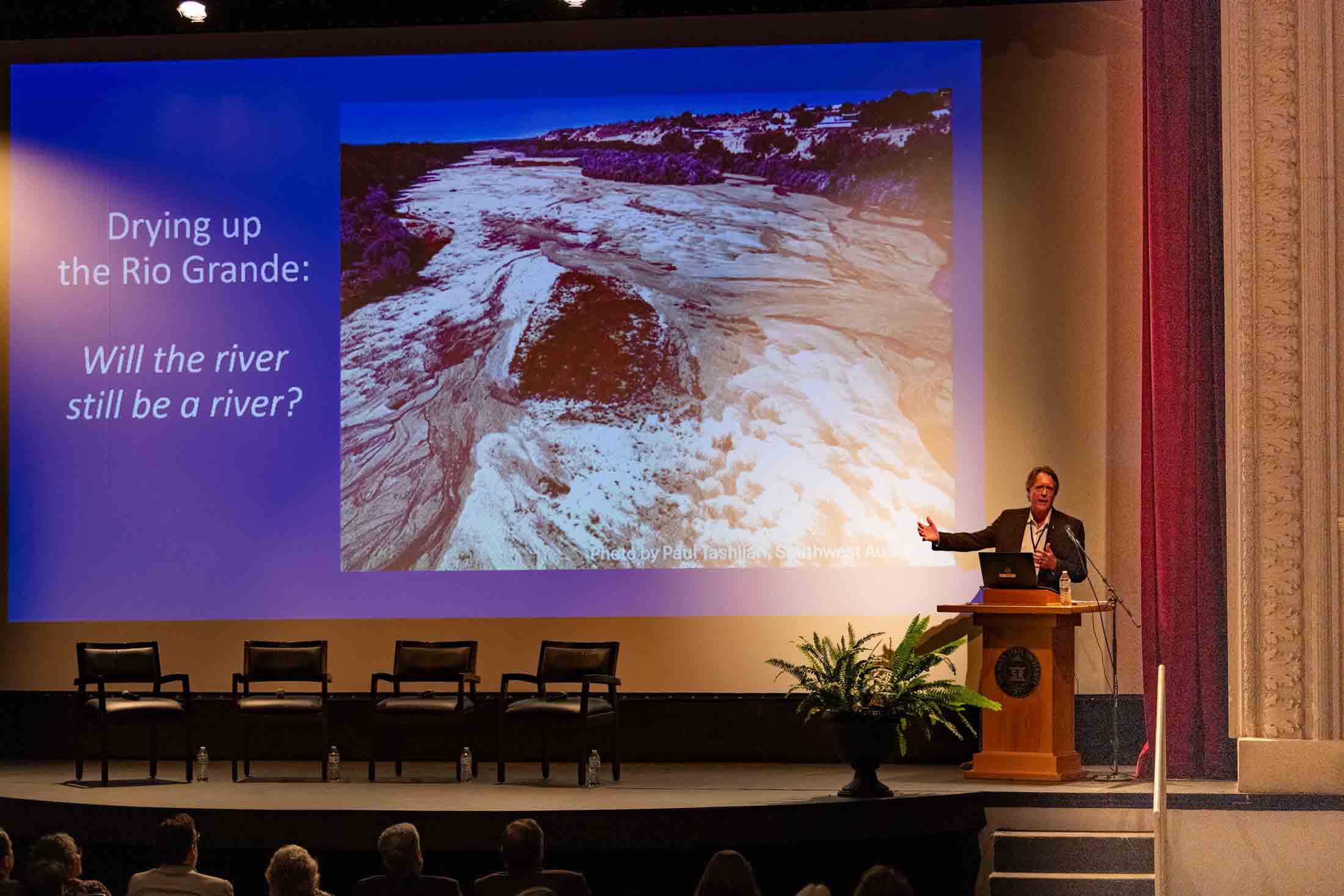
To illustrate the growing pressures on western rivers, Richter described conditions in the Rio Grande basin, where he lives in northern New Mexico.
River flows have declined in recent decades as precipitation patterns shift and overall water supplies diminish. At the same time, water demand has continued to grow.
“We’re getting less water from nature,” he said.
Reservoir storage has fallen sharply as a result. In New Mexico, reservoirs were only about 13 percent full at the end of last year, and the outlook for the coming year was even more concerning.
Agriculture accounts for roughly 90 percent of water consumption in the New Mexico portion of the basin. As surface water supplies decline, many farmers have increasingly turned to groundwater pumping to sustain their operations.
The result has been rapid aquifer depletion.
“We’re losing a half-million acre-feet of groundwater every year,” Richter said.
The connection between groundwater pumping and river flows is direct. Across the Rio Grande basin, he noted, roughly one-third of the groundwater being pumped ultimately comes at the expense of spring flows and river water.
Faced with these trends, Richter urged the audience to focus on collaborative solutions rather than searching for a single technological fix.
“There are no silver bullets,” he said. “But there are a lot of ways to approach this problem.”
Among the strategies he highlighted were what he calls “local water democracies” — community-based discussions and planning efforts that bring together water users, scientists and policymakers to determine how water resources should be managed.
In Texas, he said, groundwater conservation districts and regional water planning groups provide an important framework for those conversations.
“These are the places that you need to show up and speak up,” Richter said. “If you care about something being sustained into the future, you need to participate.”
He closed his keynote with a story from the Colorado River delta, where conservation groups and farmers collaborated in 2014 to release a temporary pulse of water down a river channel that had long run dry.
For three weeks, water flowed again through the desert channel. Families gathered along the banks, trucks lined the river, and children who had never seen the river running played in the current.
A photograph Richter showed captured the moment — people standing in the water, children splashing and laughing, their faces lit with pure joy at the return of a living river.
“If we can begin to restore the water,” he said, “we will restore the human spirit.”
Sponsors and Organizing Partners
This conference session excerpt is from Water in the Desert 2026.
Water in the Desert 2026 was hosted and organized by the Meadows Research Institute for West Texas Water at Sul Ross State University.
The conference was made possible through the generous financial support of its major sponsors — Horizon Foundation, Dixon Water Foundation, and Reeves County Groundwater Conservation District — whose leadership investment ensured the event remained accessible and affordable to attendees from across the region.
Additional sponsors included Brewster County Groundwater Conservation District, Environmental Defense Fund, EHT–Enprotec Hibbs & Todd, Frontier Development Inc., Rio Grande Joint Venture, Texas Wildlife Association, and The Nature Conservancy.
The quality and depth of the program were shaped by a collaborative team of organizing partners, including Sul Ross State University, Borderlands Research Institute, Environmental Defense Fund, Rio Grande Joint Venture, Texas Water Foundation, Texas Agricultural Land Trust, Dixon Water Foundation, Texas Wildlife Association, The Nature Conservancy, Texas Parks and Wildlife Department, and Texas Parks and Wildlife Foundation.