Opportunities provided for West Texas communities with the passage of Proposition 4, dedicating $20 billion to water infrastructure projects.
Water in the Desert 2026
Feb. 11 – 3:30 p.m. Session
If earlier panels focused on rivers and compacts, the next afternoon session turned to a different but equally urgent question: How will Texas pay for the water future it says it wants?
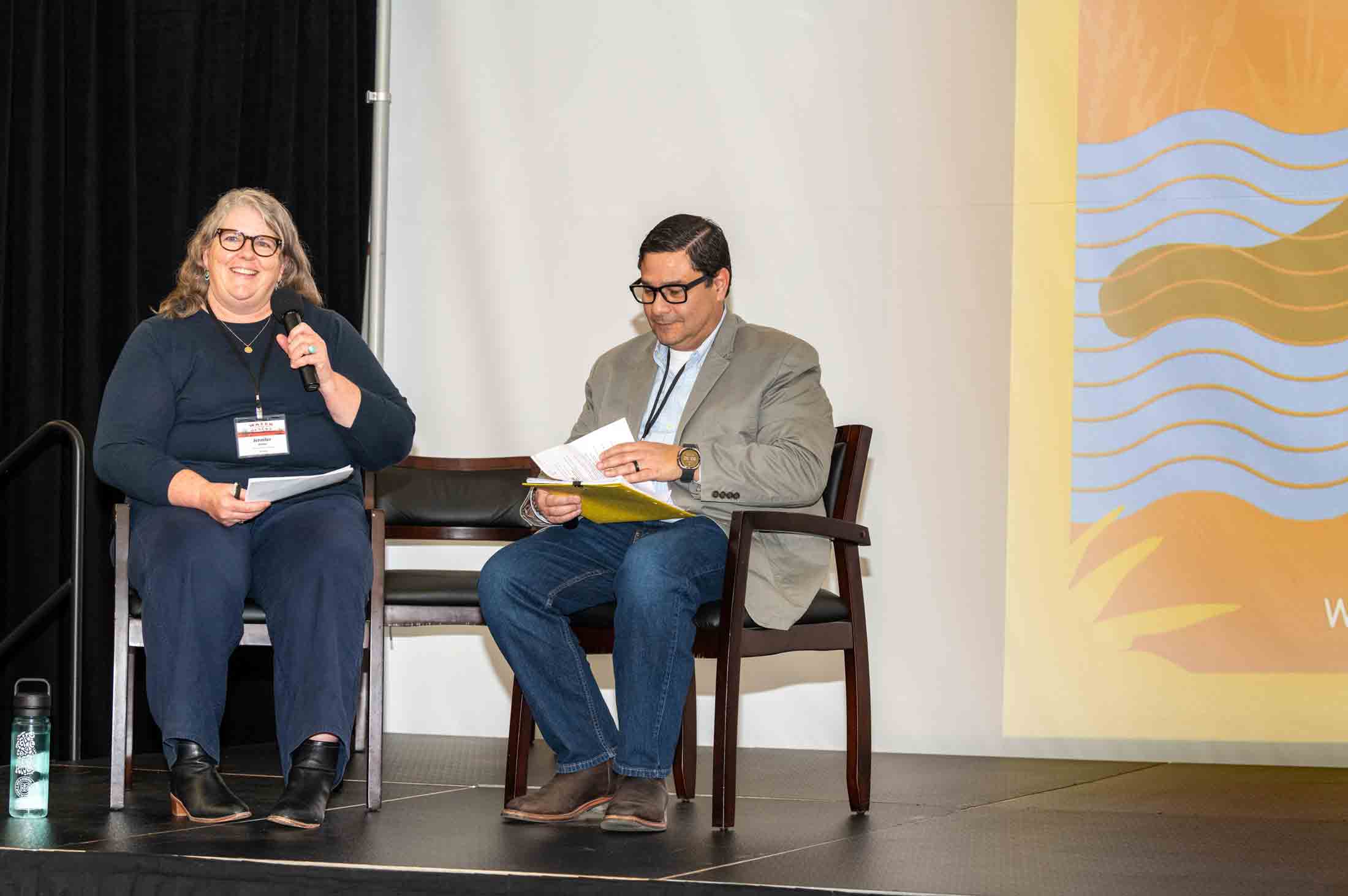
Jennifer Walker, senior program manager for the National Wildlife Federation’s Texas Coast and Water Program, joined Rogelio Rodriguez, director at Water Finance Exchange, for a candid conversation about Proposition 4, state funding programs, and the practical realities facing Texas communities seeking water infrastructure support.
The Funding Gap Is Real
Rodriguez began with a sobering statistic. Over the next 50 years, Texas is projected to need approximately $154 billion in water and wastewater infrastructure investment.
Yet in the most recent State Revolving Fund cycle, only 11 percent of clean water projects were funded. On the drinking water side, just 10 percent of applying communities received funding. In a single year, that left roughly an $8 billion gap.
Federal infrastructure funding through the Infrastructure Investment and Jobs Act provided a temporary boost, but those funds are now tapering off. And even when the money was available, many communities were not ready to access it.
“There’s a perception that communities are at a seven,” Rodriguez explained. “A lot of them are at a negative two.”
To apply for funding, utilities must have updated audits, water loss reports, drought contingency plans, emergency preparedness plans and engineering documentation. For small or rural systems, assembling those requirements can take years. That capacity gap — not just the funding gap — is one of the most significant challenges in Texas water.
Water Finance Exchange works directly with communities to build that readiness, helping them evaluate governance structures, financial sustainability and long-term resilience before applying for grants or loans.
Proposition 4 and the Texas Water Fund
Walker then outlined the legislative backdrop.
During the 88th Texas Legislature in 2023, Senate Bill 28 established the Texas Water Fund with an initial $1 billion deposit, later approved by voters. The 89th Legislature in 2025 expanded the commitment significantly.
Proposition 4, approved by voters in November with 70 percent support, creates an ongoing funding stream of up to $1 billion per year for 20 years — potentially $20 billion dedicated to water supply and infrastructure.
It marks a historic level of sustained investment in Texas water infrastructure.
In addition, House Bill 500 allocated $1.03 billion in grant funding for near-term water supply and infrastructure projects. Unlike many previous programs, this round is expected to be grant-only funding — a rare opportunity for communities.
But there is a catch.
The HB 500 funds are intended for projects that are “ready to go.” While that phrase sounds simple, it carries significant requirements. Systems must be fully compliant with regulatory and reporting obligations. Larger communities may only apply for construction funds; smaller ones may include planning and design.
For communities that are not prepared, technical assistance becomes essential.
Fixing What We Already Have
A recurring theme was the opportunity embedded in repairing existing infrastructure.
Texas currently loses an estimated 51 gallons per connection per day to water system losses — a statewide total representing tens of thousands of acre-feet annually. Addressing leakage alone could effectively create a new water supply without building new reservoirs or pipelines.
In that sense, infrastructure repair is water supply development.
The discussion also touched on gray and green infrastructure. Audience members raised the possibility of watershed restoration and land stewardship as infrastructure investments. Walker emphasized that healthy watersheds and natural systems must be part of a comprehensive water strategy, noting that community water security and environmental health are not mutually exclusive.
Regional Solutions and Legal Barriers
The conversation also highlighted the complexities of regional collaboration.
Presidio County’s experience revealed legal hurdles when multiple entities attempted to coordinate on funding applications. Under existing rules, borrowers must own the infrastructure financed by state loans, complicating regional arrangements.
Rodriguez noted that lessons from that experience helped shape recent legislation creating a Public Utility Agency framework, allowing regional entities to pursue joint projects while preserving local authority. The goal: make collaboration easier without undermining governance structures.

Getting Involved
Both speakers stressed that communities must actively engage. Key steps include reviewing regional water plans and ensuring local projects are included; monitoring Texas Water Development Board rulemaking and funding announcements; submitting public comments on proposed program guidelines; and seeking technical assistance early.
The Texas Water Development Board regularly seeks stakeholder input, and public engagement will shape how the Texas Water Fund is ultimately deployed.
What Comes Next
Throughout the session, both speakers returned to a consistent theme: funding alone will not close Texas’ water infrastructure gap.
Rodriguez emphasized that many communities are not yet positioned to compete successfully for available dollars. Readiness — including up-to-date audits, planning documents, engineering work and rate structures — determines whether a project can move forward when funding becomes available.
Walker encouraged communities to stay engaged in the process, from regional water planning to Texas Water Development Board rulemaking. Public input, she noted, will shape how the Texas Water Fund and related programs are implemented.
The passage of Proposition 4 and related legislation creates unprecedented opportunity. But as both speakers made clear, translating that opportunity into durable infrastructure will depend on preparation, coordination and sustained participation from communities across the state.
Sponsors and Organizing Partners
This conference session excerpt is from Water in the Desert 2026.
Water in the Desert 2026 was hosted and organized by the Meadows Research Institute for West Texas Water at Sul Ross State University.
The conference was made possible through the generous financial support of its major sponsors — Horizon Foundation, Dixon Water Foundation, and Reeves County Groundwater Conservation District — whose leadership investment ensured the event remained accessible and affordable to attendees from across the region.
Additional sponsors included Brewster County Groundwater Conservation District, Environmental Defense Fund, EHT–Enprotec Hibbs & Todd, Frontier Development Inc., Rio Grande Joint Venture, Texas Wildlife Association, and The Nature Conservancy.
The quality and depth of the program were shaped by a collaborative team of organizing partners, including Sul Ross State University, Borderlands Research Institute, Environmental Defense Fund, Rio Grande Joint Venture, Texas Water Foundation, Texas Agricultural Land Trust, Dixon Water Foundation, Texas Wildlife Association, The Nature Conservancy, Texas Parks and Wildlife Department, and Texas Parks and Wildlife Foundation.